Joe Overstreet
(1933-2019)
Study for Black Star Line
1990
charcoal on paper
18 x 11 1/2 inches
signed
label verso: Kenkeleba House, 214-16,
East Second Street, New York, New York, 1000
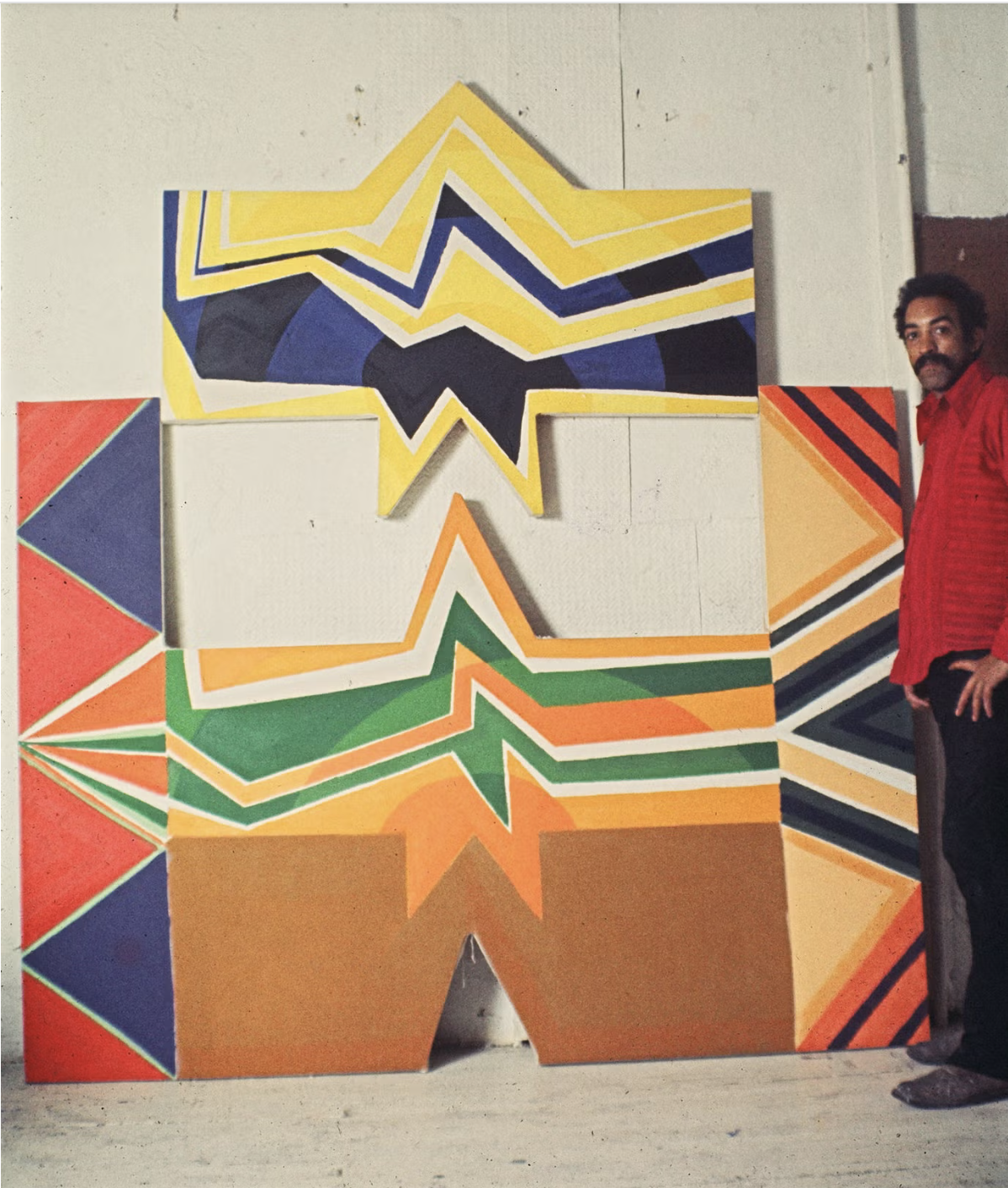
Joe Overstreet with his painting “North Star” (1968).Credit...Joe Overstreet/Artists Rights Society (ARS), New York, via Eric Firestone Gallery, New York.
Painter and cultural organizer Joe Overstreet expanded the possibilities of abstraction through an inventive exploration of materials, structure, and space. His work connected formal experimentation with the histories and experiences of African Americans, making freedom both a subject and a guiding principle of his practice. From shaped canvases to paintings suspended by ropes, he challenged the boundaries of the conventional picture while helping create opportunities for artists overlooked by mainstream institutions.
Born in Conehatta, Mississippi, Overstreet moved with his family several times before settling in Berkeley, California. He studied at Contra Costa College and the California School of Fine Arts, establishing a studio in San Francisco’s North Beach neighborhood. Artists Sargent Johnson and Raymond Howell became important mentors, while the Bay Area’s jazz clubs, galleries, and Beat literary community provided settings for his early exhibitions. In 1958, he moved to New York, where relationships with artists including Romare Bearden, Willem de Kooning, Franz Kline, and Hale Woodruff deepened his engagement with painting.
During the 1960s, Overstreet’s work responded directly to the Civil Rights Movement and the emergence of Black cultural nationalism. In The New Jemima, he transformed a familiar commercial stereotype into an armed figure of resistance. He also served as art director for Amiri Baraka’s Black Arts Repertory Theatre/School in Harlem. These activities reflected his conviction that artistic invention and community action could participate in the same struggle for self-determination.
By the late 1960s, Overstreet was constructing angular, shaped canvases that departed from the rectangular frame. In his Flight Patterns, begun in 1970, he released painted canvas from its stretcher and tethered it to walls, floors, and ceilings with ropes. Colorful fabric became a sculptural presence, inviting viewers to move around and through the work. The tension between buoyant canvas and restraining cords carried historical and political associations, including the violence of lynching and the desire for liberation. His later Facing the Door of No Return paintings followed a 1992 visit to Senegal, where the House of Slaves on Gorée Island prompted a sustained meditation on ancestry and displacement.
His works on paper provide another setting for these investigations. In Study for Black Star Line (1990), broad charcoal passages intersect with looping, sharply drawn lines that suggest ropes and rigging. The contrast between dark masses and open areas creates a sense of both suspension and restraint. In his Smithsonian oral history, Overstreet connected the related painting to Marcus Garvey’s shipping enterprise and described its vessel as tethered to the docks, unable to move. Read alongside that account, the drawing joins his longstanding interest in spatial tension with a reflection on the promise and frustration of collective freedom.
In 1974, Overstreet cofounded Kenkeleba House with curator Corrine Jennings and writer Samuel C. Floyd. The organization provided exhibition opportunities and supported experimentation across visual art, music, poetry, dance, and theater. Its commitment to African American artists and other underrepresented communities made it an enduring expression of his belief that cultural independence required spaces in which artists could work, gather, and be seen.
Overstreet remained active until his death in New York in 2019. Renewed recognition came with Joe Overstreet: Taking Flight, presented at the Menil Collection in 2025 and subsequently at the Mississippi Museum of Art in 2025–2026. His work is held in collections including the Menil Collection, Brooklyn Museum, Museum of Fine Arts, Boston, and Berkeley Art Museum and Pacific Film Archive. His legacy encompasses both a radical rethinking of painting and the cultural infrastructure he helped build for generations of artists.