Gordon Parks
(1912-2006)
Women Welders at the Landers, Frary, and Clark Plant, New Britain, CT
1943
gelatin silverprint
9 x 7 inches (image)
unsigned, numerals written in pencil verso
In this photograph, made in June 1943 for the Office of War Information, Gordon Parks portrayed two African American women welders at the Landers, Frary, and Clark plant in New Britain, Connecticut. Their participation in skilled industrial work reflects the changing employment opportunities of World War II, even as racial and gender discrimination continued to limit access. Parks’s low viewpoint and dramatic lighting give the women a monumental presence, emphasizing their competence and dignity. The image offers an important record of Black women’s contributions to the wartime workforce and an early example of Parks’s ability to unite social documentation with expressive portraiture.
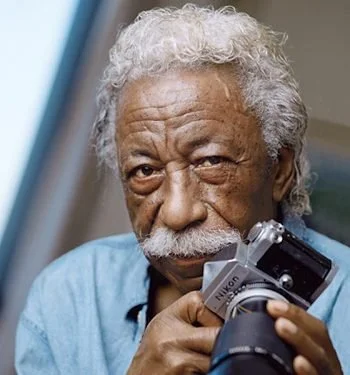
Photographer, filmmaker, writer, and composer Gordon Parks devoted his life to revealing the humanity of people whose experiences were often overlooked or misrepresented. His photographs exposed the consequences of racism and poverty while affirming the dignity, beauty, and complexity of Black life. Equally accomplished in documentary photography, portraiture, and fashion, Parks combined a storyteller’s sensitivity with a sophisticated understanding of light and composition. His creative achievements opened doors for African American artists across several fields.
Born in Fort Scott, Kansas, in 1912, Parks grew up amid poverty and segregation. Following his mother’s death, he moved to Minnesota as a teenager, where periods of homelessness and precarious employment sharpened his awareness of social inequality. While working as a railroad dining-car waiter, he encountered magazine photographs documenting the Depression, including images by Farm Security Administration photographers Dorothea Lange and Arthur Rothstein. Recognizing photography’s potential to confront injustice, he purchased his first camera in 1937, at the age of twenty-five, and taught himself to use it. Early portraits and fashion assignments helped establish his reputation in the Twin Cities.
After moving to Chicago in 1941, Parks found an important artistic community at the South Side Community Art Center, which provided studio and darkroom space. His friendships with Charles White, Eldzier Cortor, and Margaret Burroughs encouraged his development; White urged him to photograph neighborhood life. In 1942, Parks became the first photographer awarded a Julius Rosenwald Fellowship, enabling him to work with Roy Stryker at the FSA in Washington, D.C. There he photographed Ella Watson, a government cleaning woman whose portrait, American Gothic (1942), became one of his defining images. Watson’s upright figure, framed by an American flag and her cleaning tools, gave powerful visual form to the contradictions between national ideals and racial inequality.
Parks subsequently worked for the Office of War Information and Stryker’s documentary project at Standard Oil, while building a freelance career. He also photographed distinguished African Americans for Edwin R. Embree’s Thirteen Against the Odds, published in 1944. His 1948 Life photo essay, Harlem Gang Leader, followed seventeen-year-old Red Jackson and brought Parks the opportunity to become the magazine’s first African American staff photographer. During approximately two decades at Life, his assignments encompassed international fashion, celebrity portraits, urban poverty, and the struggle for civil rights.
His major photographic projects made broad social concerns intimate and tangible. Segregation Story (1956) documented Black families navigating Jim Crow Alabama, while The Atmosphere of Crime (1957) examined policing and incarceration. His 1961 photographs of Flávio da Silva, a young boy living in poverty in Rio de Janeiro, and his 1967 study of Harlem’s Fontenelle family demonstrated his sustained concern for children and families. In 1963, his reporting on the Nation of Islam brought readers close to Malcolm X, Elijah Muhammad, and the community surrounding them. Parks’s ability to establish trust enabled him to portray individuals whose lives could not be adequately conveyed through stereotypes or sensational headlines.
Writing and filmmaking expanded his capacity to tell these stories. His semiautobiographical novel The Learning Tree(1963), rooted in his Kansas childhood, became a film in 1969 that he wrote, directed, and scored, making him the first African American to direct a major Hollywood studio feature. Shaft (1971) followed, achieving commercial success and establishing a commanding Black protagonist within mainstream cinema. His books included the memoir A Choice of Weapons (1966), poetry collections, and later volumes pairing writing with increasingly abstract photographs. A lifelong musician, Parks also composed orchestral works and music for Martin, a ballet honoring Martin Luther King Jr.
Parks continued creating into his final years and received the National Medal of Arts in 1988. He died in 2006 at ninety-three. His legacy remains active through the Gordon Parks Foundation and through exhibitions such as Gordon Parks: Camera Portraits from the Corcoran Collection, presented at the National Gallery of Art in 2024–2025. Across his varied work, Parks demonstrated how artistic expression could confront injustice while preserving the individuality and dignity of those before his lens.