Romare Bearden
(1911-1988)
“Art is always made from other art,
and you just have to find your place.”
-Romare Bearden
Jazz II Deluxe
1980
color screenprint
26-3/4 x 37-1/2 inches, full margins.
signed
Gelburd/Rosenberg GG#100
Romare Bearden was born in 1911 in Charlotte, North Carolina, but raised largely in New York City. His parents were active participants in the Harlem Renaissance (his mother was the New York editor of the Chicago Defender), which provided the artistic and intellectual foundation for him to emerge as an artist of genuine talent, versatility, and conviction.
Bearden studied at New York University, the Art Students League with George Grosz, and Columbia University. He was involved with the earliest incarnation of the Harlem Artists Guild and Charles Alston’s 306 group. After serving with the army, he was able to travel to Paris and study at the Sorbonne. When he returned from his travel, his early Social Realist works gradually gave way to cubism in the mid 1940’s while he began exploring religious and mythological themes.
In the early 1960’s, Bearden joined the artist collective Spiral, and began making collages as “an attempt to redefine the image of man in terms of the black experience.” Bearden’s early collages were composed primarily of magazine and newspaper cuttings. Together with his Projections, which were enlarged photostatic copies of these collages, they mark a turning point in his career and received critical praise.
Bearden achieved success in a wide array of media and techniques, including watercolor, gouache, oil, drawing, monotype, and edition prints. He also designed record albums, costumes, stage sets, and book illustrations. Bearden opened Cinque Gallery with fellow artists Norman Lewis and Ernest Crichlow and was a founding member of the Studio Museum in Harlem and the Black Academy of Arts and Letters. His work is included in major public collections, including the Metropolitan Museum of Art, NY; Whitney Museum of American Art, NY; Philadelphia Museum of Art, PA; Museum of Fine Arts, Boston; and the Studio Museum in Harlem, NY.
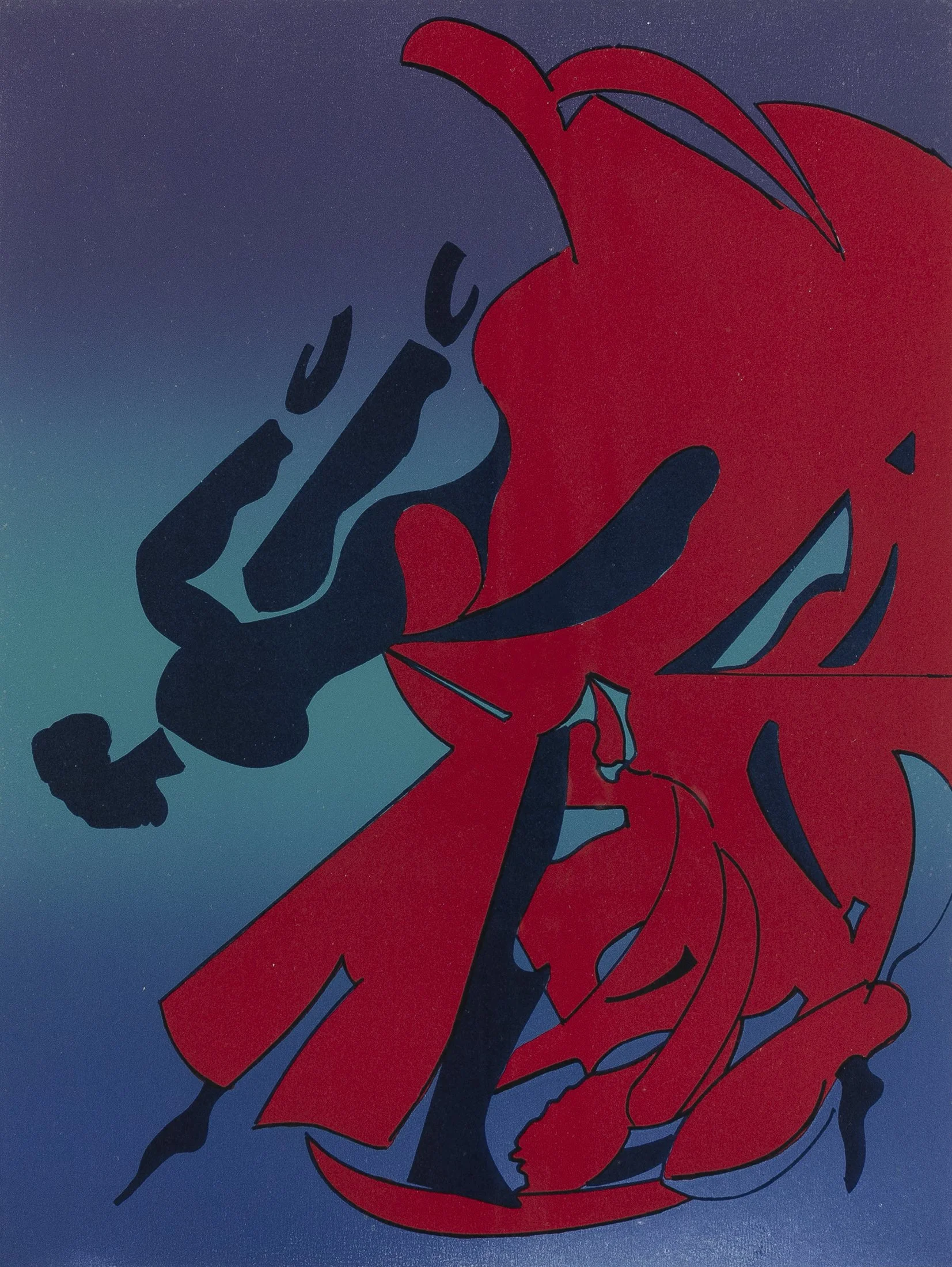
Dancer
c. 1982
color lithograph
18-1/2 x 14 inches, full margins
28-1/8 x 22-1/4 inches (sheet)
signed and numbered, 11/50
Selected Exhibitions
ROMARE BEARDEN: Oils, Gouaches, Water Colors, Drawings, 1937-1940; 306 W. 141st, NY, NY, 1940
American Exhibition of Painting and Sculpture 58th Annual: Abstract and Surrealist American Art; Art Institute of Chicago, IL, 1948
Barone Gallery, NY, NY, 1955
ROMARE BEARDEN: Projections; Corcoran Gallery of Art, Washington, DC, 1965
ROMARE BEARDEN: Paintings and Projections; SUNY, Albany, NY, 1968
Museum of the National Center of Afro-American Artists, Boston, MA, 1977
ROMARE BEARDEN 1970-1980; Mint Museum of Art, Charlotte, NC, 1980.
ROMARE BEARDEN: Origins and Progressions; Detroit Institute of Arts, MI, 1986
ROMARE BEARDEN: New York Scenes; Bronx Museum of the Arts, NY, 2005
Conjuring BEARDEN; Nasher Museum of Art, Duke University, Durham, NC, 2006
Buried Treasures: Art in African American Museums; DuSable Museum of African American History, Chicago, IL, 2012
Something Over Something Else: Romare Bearden’s Profile Series; Cincinnati Art Museum, Cincinnati, OH, 2020
Romare Bearden: Artist as Activist and Visionary; Long Island Museum, Stony Brook, NY, 2024
Romare Bearden: Resonances; Saint Louis Art Museum, 2024
The Harlem Renaissance and Transatlantic Modernism; Metropolitan Museum of Art, New York, NY, 2024 (group)
416: Romare Bearden; Museum of Modern Art, New York. An ongoing collection gallery devoted entirely to Bearden, with several works currently displayed.
Summertime and All That Jazz; Debra Force Fine Art, New York, through September 11, 2026. Includes Bearden’s collage Time for the Drum (1979).
David C. Driskell & Friends: Creativity, Collaboration, and Friendship; Frost Art Museum, Miami, through October 11, 2026. Features Bearden among more than 35 African American artists connected to Driskell.