Radcliffe Bailey
(1968-2023)
I’ve always felt like the only way I can heal myself throughout certain things is to go back through my memory, learn from memory.
-Radcliffe Bailey
Untitled
2005
mixed media collage
36 x 24-1/2 inches
signed and dated verso, 6/15/05
Radcliffe Bailey transformed photographs, found objects, painted forms, and fragments of material culture into meditations on ancestry, migration, and the persistence of historical memory. Moving fluidly among painting, collage, sculpture, and installation, he developed a richly layered visual language in which personal history became inseparable from the broader experience of the African diaspora. His work often functions as a kind of poetic archive assembled through intuition, association, and inherited knowledge rather than conventional chronology.
Born in Bridgeton, New Jersey, Bailey moved with his family to Atlanta at the age of four. Childhood visits to the High Museum of Art helped cultivate his interest in art, while Atlanta’s complex history, its central role in the Civil Rights Movement, as well as its proximity to the landscapes of slavery and the Civil War, provided an enduring source of imagery and inquiry. Bailey studied sculpture at the Atlanta College of Art, receiving his BFA in 1991. Although trained as a sculptor, he resisted distinctions among media, constructing works that might incorporate paint, photographs, wood, glass, metal, textiles, maps, railroad tracks, piano keys, and other objects charged with cultural or personal meaning.
Archival photographs occupy a particularly important place in Bailey’s work. Initially drawn from albums belonging to his grandmother, and later supplemented by found images, these photographs allowed him to restore individual presence to histories too often rendered anonymous. He surrounded such images with fields of color, abstract geometry, African symbols, botanical forms, and materials suggesting travel or displacement. Trains, ships, oceans, and constellations recur throughout his work, evoking both forced and voluntary migrations, from the Middle Passage to the movement of Black families across the American South and during the Great Migration. Music, especially jazz, offered Bailey another model for joining fragments into an expressive whole: historical references are repeated, improvised upon, and transformed much as a musician might reinterpret an established theme.
The work illustrated here, formerly in the Kerry and C. Betty Davis Collection, exemplifies Bailey’s ability to unite intimate memory with cultural history. At its center, an archival photograph of two formally dressed men is embedded within an animated field of green, punctuated by vigorous painted lines, organic motifs, dark geometric forms, and passages of vivid color. The branching lines suggest roots, pathways, or a family tree, while the fragmented shapes surrounding the photograph create the impression of memory continually being uncovered and reassembled. Rather than functioning as a static record of the past, the photograph becomes an active presence within the composition.
Bailey received a Joan Mitchell Foundation grant in 2008 and the Elizabeth and Mallory Factory Prize for Southern Art in 2010. His major traveling survey, Radcliffe Bailey: Memory as Medicine, opened at the High Museum of Art in 2011. His work is represented in numerous institutional collections, including the Metropolitan Museum of Art, the National Gallery of Art, the Smithsonian American Art Museum, the Art Institute of Chicago, the High Museum of Art, and the Museum of Fine Arts, Houston. Through his fusion of private remembrance and collective history, Bailey created an art of recovery, one that acknowledges historical trauma while affirming continuity, resilience, and the sustaining power of ancestral memory.
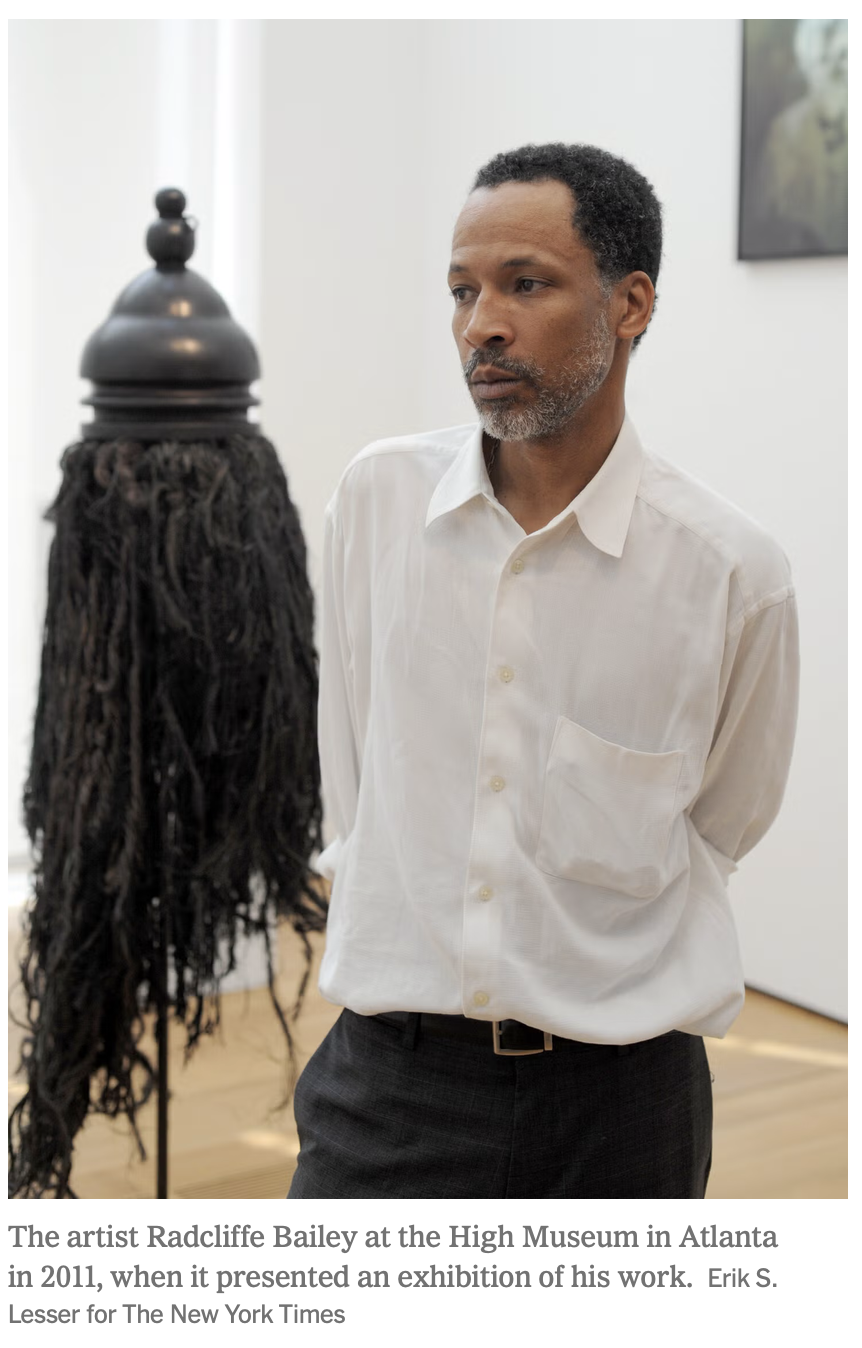
The artist Radcliffe Bailey at the High Museum in Atlanta in 2011, when it presented an exhibition of his work. Erik S. Lesser for The New York Times
Selected Exhibitions
RADCLIFFE BAILEY; Fay Gold Gallery, Atlanta, GA, 1993.
RADCLIFFE BAILEY: Recent Paintings and Works on Paper; Fay Gold Gallery, Atlanta, GA, 1994.
RADCLIFFE BAILEY: The Magic City; Birmingham Museum of Art, AL, 2000.
RADCLIFFE BAILEY: From the Cabinet, Reflections of Winding Roads; Jack Shainman Gallery, NY, 2005.
Flow - Paintings and Installations by RADCLIFFE BAILEY; Jacksonville Museum of Contemporary Art, FL, 2006.
RADCLIFFE BAILEY: Looking for Light, Traveling by Night; Solomon Projects, Atlanta, GA, 2009.
RADCLIFFE BAILEY: Art of an Ancient Soul; High Museum of Art, Atlanta, GA, 2010.
Between Two Worlds: The Art of RADCLIFFE BAILEY; Harvey B. Gantt Center for African American Arts and Culture, Charlotte, NC, 2010.
RADCLIFFE BAILEY: Memory as Medicine; High Museum of Art, Atlanta, GA, 2011. Traveled to: Davis Museum and Cultural Center, Wellesley College, Wellesley, Massachusetts, February 15–May 6, 2012; McNay Art Museum, San Antonio, Texas, June 6–September 2, 2012.
Radcliffe Bailey: Pensive; Gibbes Museum of Art, Charleston, SC, 2018.
Radcliffe Bailey: Ascents and Echoes; Jack Shainman Gallery, NY, 2021.
The Dirty South: Contemporary Art, Material Culture, and the Sonic Impulse; Virginia Museum of Fine Arts, 2021.
Afro-Atlantic Histories; Museum of Fine Arts, Houston, TX; 2021–22.
Radcliffe Bailey: Passages; Knoxville Museum, Knoxville, TN, 2022.
Then Is Now: Contemporary Black Art in America; Bruce Museum, Greenwich, CT, 2023.
With Passion and Purpose: Gifts from the Collection of Larry D. and Brenda A. Thompson; National Gallery of Art, Washington, DC, 2025.
Soft Architectures: Paper as Structure, Idea & Translation; Bridgette Mayer Gallery, Philadelphia, PA, March 4–August 1, 2026