John Thomas Biggers
(1924-2001)
The role of art is to express the triumph of the human spirit over the mundane and the material. It is also to express the universal myths and archetypes of the universal family of man…. My motivation is to portray the very rare and unseen spirituality of the Afro-American that is universal for all mankind.
-John T. Biggers
Above My Head
1964
lithograph
9 × 12 inches, full margins
signed, dated, titled, and numbered 8/9
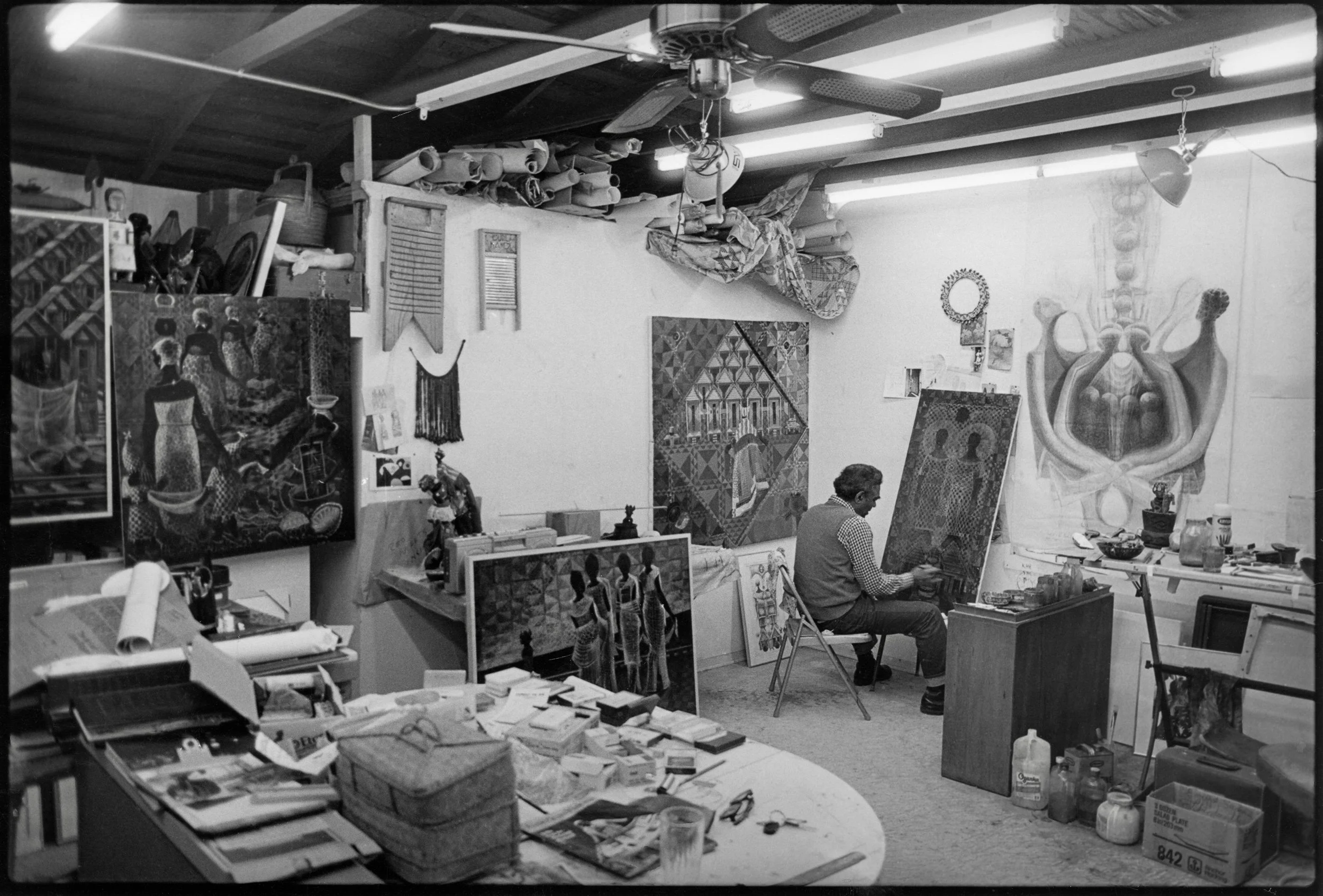
Photo: Earlie Hudnall, Jr., John Biggers in His Studio, 1986; Image courtesy of the artist
Born in Gastonia, North Carolina in 1924, John Biggers developed one of the most complex and symbolically rich bodies of work in twentieth-century American art. His early training at the Hampton Institute in the 1940s, where he studied alongside artists such as Charles White and Elizabeth Catlett, grounded him in a social realist tradition that emphasized the dignity and labor of African American life. These early works, often focused on scenes of toil and endurance, laid the foundation for his later, more expansive visual language.
A pivotal shift occurred following his move to Houston in 1949, where he founded and chaired the art department at Texas State University for Negroes (now Texas Southern University). It was here that Biggers began to move beyond social realism, developing a highly structured, symbolic mode of representation. His 1957 UNESCO-sponsored journey to Ghana and Nigeria proved transformative, providing direct engagement with West African cultural and artistic traditions. From this point forward, his work increasingly synthesized African cosmology, Southern Black vernacular culture, and modernist design into a unified visual system.
Across his mature oeuvre, Biggers constructed compositions that operate simultaneously as narrative, pattern, and spiritual diagram. Recurring motifs like shotgun houses, quilting patterns, trees of life, vessels, and maternal figures, function not merely as descriptive elements, but as carriers of cultural memory and continuity. His use of geometry is particularly significant: forms are carefully ordered into rhythmic, almost architectural arrangements, suggesting an underlying harmony that connects past and present, Africa and the American South, the individual and the collective.
Biggers remained a deeply influential educator and cultural figure throughout his career, shaping generations of artists at Texas Southern University while continuing to produce murals, drawings, and paintings of remarkable complexity. He died in Houston in 2001. Today, his work is recognized not only for its aesthetic achievement, but for its profound articulation of a diasporic vision, one in which history, spirituality, and everyday life are woven into a cohesive and enduring whole.
Selected Exhibitions
Young Negro Art; Museum of Modern Art, New York, NY, 1943
3rd Annual Exhibition of Paintings, Sculptures and Prints by Negro Artists; Atlanta University, Atlanta, GA; 1944, 1947, 1950, 1953
Pennsylvania State University, University Park, PA, 1951
Drawings of West Africa: Dr. John Biggers; Museum of Fine Arts, Houston, TX, 1962
Two Centuries of Black American Art: 1750-1950; Los Angeles County Museum of Art, CA, 1976
The Web of Life in Africa: An Exhibition of Drawings and Paintings by John T. Biggers; African American Cultural Center, Dallas, TX, 1978
Black Art – Ancestral Legacy: The African Impulse in African–American Art; Dallas Museum of Art, Dallas, TX, 1989
John Biggers: View from the Upper Room; Museum of Fine Arts, Houston, TX, 1995
Remembering John Biggers (1924-2001): A Memorial Exhibition; National Center of Afro-American Artists, Boston, MA, 2001
John Biggers: My America; Michael Rosenfeld Gallery LLC, New York, NY; New Orleans Museum of Art, New Orleans, LA, 2004
The Art of John Biggers; Los Angeles County Museum of Art, Los Angeles, CA, 2010
John Biggers: Wheels in Wheels; Mint Museum, Charlotte, NC, 2016
Circle of Influence: The Art of John Biggers; Art Museum of South Texas, 2018
The Web of Life: John Biggers and the Power of Pedagogy; Palmer Museum of Art, Penn State, University Park, PA, 2019
The Dirty South: Contemporary Art, Material Culture, and the Sonic Impulse; Virginia Museum of Fine Arts, Richmond, VA, 2021
Figures and Projections; Kutztown University, PA, 2021
Charles White: Influences; Rockland Center for the Arts, Nyack, NY, 2022
Queens, Gods, and Devotees; Frances M Maguire Art Museum, St. Joseph’s University, Merion, PA, 2024
Claiming Freedom: Selections from the Petrucci Family Foundation Collection of African American Art; Lafayette College, Skillman Library, Easton, PA, 2024
John Biggers: Dance of Creation; Hampton University Museum, Hampton, VA, 2025
With Passion and Purpose: Gifts from the Collection of Larry D. and Brenda A Thompson; National Gallery of Art, Washington, DC, 2025