Camille Billops
(1933-2019)
I talked about my racism. I said, “Look at it this way. It’s a bad servant, it does not deliver what you want it to deliver.
-Camille Billops
Study for KKK Boutique
1994
pen drawing
14 × 11 inches (image)
21 × 18 inches (full sheet)
signed, dated, titled, and inscribed NYC
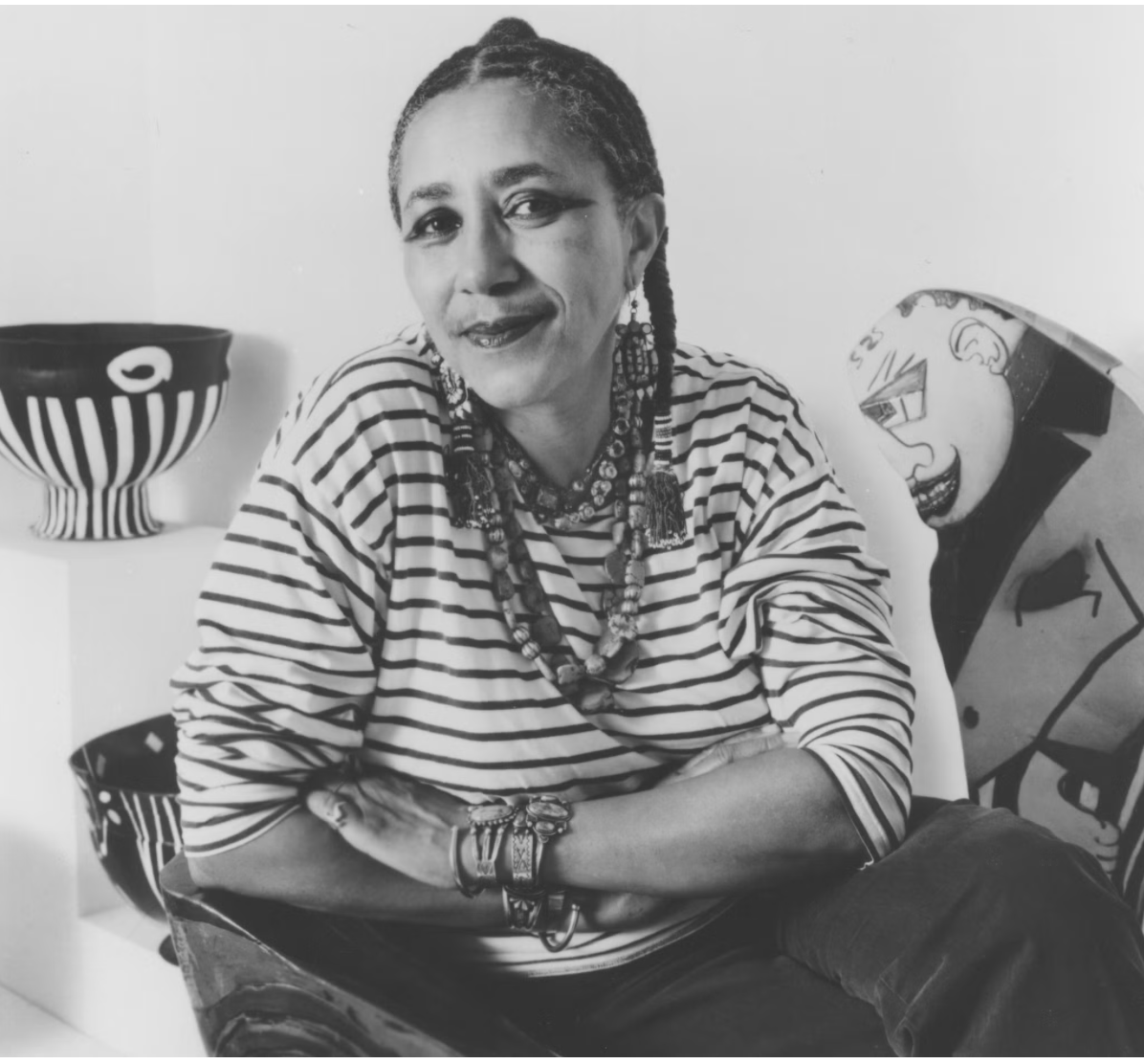
Photo: Steve Walters for the New York Times
Camille Billops built a multifaceted career around the power of personal memory and the preservation of Black cultural history. A sculptor, printmaker, filmmaker, and archivist, she approached art as a means of questioning received ideas about race, gender, and identity. Born in Los Angeles, Billops began working in ceramics in the late 1950s, developing a practice that would expand to include prints, photography, and film. Extensive travel, including time in Egypt, Ghana, India, Japan, and Taiwan, broadened her artistic vocabulary and informed her understanding of Black identity within an international context.
Billops’s visual art combined personal narrative with an often provocative examination of social conventions. Her ceramic figures, sculptural objects, and mirrors could be playful or unsettling, while her prints brought similar concerns into richly worked compositions. In 1973, she began studying printmaking at Robert Blackburn’s workshop, learning from Romare Bearden and Krishna Reddy. The following year, she participated in the inaugural exhibition at Linda Goode Bryant’s Just Above Midtown gallery, an important gathering place for Black artists working beyond established expectations. Across these settings, Billops developed an independent voice, drawing freely upon family history, cultural traditions, and the contradictions of everyday life.
Her turn to filmmaking in the 1980s extended this willingness to address difficult subjects. Working with her husband and creative partner, theater historian James V. Hatch, she made films that examined family relationships, racism, and women’s autonomy. Among the most significant was Finding Christa (1991), which explored her decision to place her daughter for adoption and their subsequent reunion. Awarded the documentary Grand Jury Prize at the 1992 Sundance Film Festival, the film challenged conventional expectations of motherhood while demonstrating Billops’s commitment to telling intimate stories on her own terms.
That commitment to self-representation also shaped her work as an archivist. Billops and Hatch transformed their SoHo loft into a meeting place for artists, writers, and scholars, recording conversations that preserved voices frequently overlooked by cultural institutions. In 1981, they began publishing Artist and Influence, a journal devoted to these oral histories. Their extensive collection of interviews, books, photographs, exhibition materials, and theater scripts, donated to Emory University beginning in 2002, became a major resource for the study of African American arts and letters. Billops’s legacy thus encompasses both the art she created and the histories she helped safeguard. Her inclusion in the Museum of Modern Art’s Just Above Midtown: Changing Spaces (2022–2023) reaffirmed her place within a community whose experiments and activism reshaped American art.
Study for KKK Boutique (1994) offers a particularly revealing connection between her work on paper and her filmmaking. In the drawing, animated figures, hooded Klansmen, crosses, and swastikas occupy a disorienting landscape of winding forms. The spare outlines and exaggerated gestures give the scene a theatrical character, making its imagery of hatred and intimidation all the more disturbing. The work belongs to the same thematic exploration as The KKK Boutique Ain’t Just Rednecks, the film Billops made with James V. Hatch in 1994. Combining satire, staged encounters, and documentary material, the film examined racism’s pervasive presence in American life and pressed viewers to consider their own participation in prejudice. Viewed in this context, the drawing demonstrates how Billops carried an idea across media, using visual invention to confront subjects that polite conversation often avoided.