Claude Clark
(1915-2001)
Black is a culture and not just a color.
-Claude Clark
Sister and Brother
1949
oil on board
9 × 12 inches
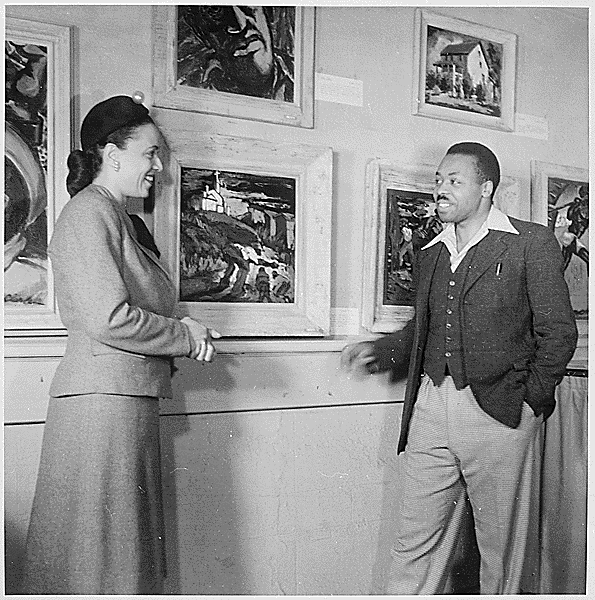
Photo: Claude Clark exhibit at ROKO Galleries; National Archives Catalog, Harmon Foundation Collection 1922 – 1967, Negro Art Exhibits, Workshops and Demonstrations 1935 – 1947
Claude Clark was born on a tenant farm in Rockingham, Georgia. In 1923, his family joined the Great Migration, settling in the Manayunk section of Philadelphia in search of greater economic and educational opportunities. Clark’s early interest in art and literature led to a four-year scholarship at the Pennsylvania Museum and School of Industrial Art, where he studied from 1935 to 1939. He subsequently attended the Barnes Foundation, studying its exceptional holdings of European modernism and African art. His encounters with the paintings of Vincent van Gogh and Paul Cézanne encouraged his lifelong preference for applying paint with a palette knife, creating richly textured compositions characterized by saturated color, simplified forms, and expressive movement.
During the Depression, Clark worked in the Philadelphia graphics division of the Works Progress Administration’s Federal Art Project, where his colleagues included Dox Thrash and Raymond Steth. Their influence deepened his interest in printmaking and socially engaged art. His paintings from this period addressed labor, military service, urban life, music, and the psychological experiences of ordinary people. In 1945, Clark exhibited Soldering and Work Song in the influential traveling exhibition The Negro Artist Comes of Age: A National Survey of Contemporary American Artists, organized by the Albany Institute of History and Art and subsequently presented at the Brooklyn Museum.
Clark’s growing reputation brought solo exhibitions at the Artists’ Gallery in Philadelphia, Bonestell Gallery, and Michael Freilich’s Roko Gallery in New York. In 1944, Albert C. Barnes acquired Clark’s painting Cutting Pattern, making him the second living African American artist, after Horace Pippin, represented in the Barnes Foundation’s collection.
In 1948, Clark returned to the South to chair and develop the art department at Talladega College. He remained there until 1955, when he was succeeded by David C. Driskell. After relocating to California, Clark continued his studies at Sacramento State University and the University of California, Berkeley, and taught at institutions including San Francisco State University and Merritt College. At Merritt, he authored A Black Art Perspective: A Black Teacher’s Guide to a Black Visual Arts Curriculum (1970), an important contribution to culturally relevant art education during the Black Arts Movement.
Clark’s work is currently included in David C. Driskell & Friends: Creativity, Collaboration, and Friendship at the Frost Art Museum in Miami, through October 11, 2026. The inclusion is particularly meaningful because Driskell succeeded Clark at Talladega College in 1955.
“Claude Clark ... presents ... an art in which strong feelings are translated into paint. Forceful army scenes, figure studies...and powerful landscapes reveal Clark’s concern with human and psychological values. Brilliant color harmonies and a moving sense of design contribute to their achievement. The flower paintings show his feeling for color at its purest…”
At the Crossing
c. 1955
oil on board
12 × 9 inches
signed
Selected Exhibitions
First Annual Exhibition on Art; Pyramid Club, Philadelphia, PA, 1941
CLAUDE CLARK; Artist's Gallery of Philip Ragan Associates, NY, NY, 1944
The Negro Artist Comes of Age: A National Survey of Contemporary American Artists; Albany Institute of History and Art, NY, 1945
Exhibition of Graphic Arts and Drawings by Negro Artists; Howard University Gallery of Art, Washington, DC, 1947
Roko Gallery, NY, NY, 1946, 1947
Claude Clark; E.B. Crocker Art Museum, Sacramento, CA, 1956
New Perspectives in Black Art; Kaiser Center Gallery, Oakland Museum of Art, CA, 1968
A Retrospective Exhibition, 1937-1971: Paintings by CLAUDE CLARK; Carl Van Vechten Gallery, Fisk University, TN, 1972
Prints & Drawings 1977; San Francisco African American Historical and Cultural Society, CA, 1977.
Reflections of a Southern Heritage: 20th Century Black Artists of the Southeast; Gibbes Art Gallery, Charleston, SC, 1979
Choosing: An Exhibit of Changing Perspectives in Modern Art and Art Criticism by Black Americans, 1925-1985; Hampton University, VA, 1985
Unbroken Circle: Exhibition of African American Artists of the 1930's and 1940’s; Kenkeleba House, NY, NY, 1986
Fifty Years of Paintings by Georgia Artist CLAUDE CLARK; Hammonds House Museum, Atlanta, GA, 1990
Free Within Ourselves: African-American Artists in the Collection of the National Museum of American Art; National Museum of American Art, Washington, DC, 1992
Narratives of African American Art and Identity: The David C. Driskell Collection; University of Maryland Art Gallery, College Park, MD, 1998
In Search of Missing Masters: The Lewis Tanner Moore Collection of African American Art; Woodmere Art Museum, Philadelphia, PA, 2009
African American Art: Harlem Renaissance, Civil Rights Era and Beyond; American Art Museum, Smithsonian Institution, Washington, DC, 2012