Ralph Chessé
(1900-1991)
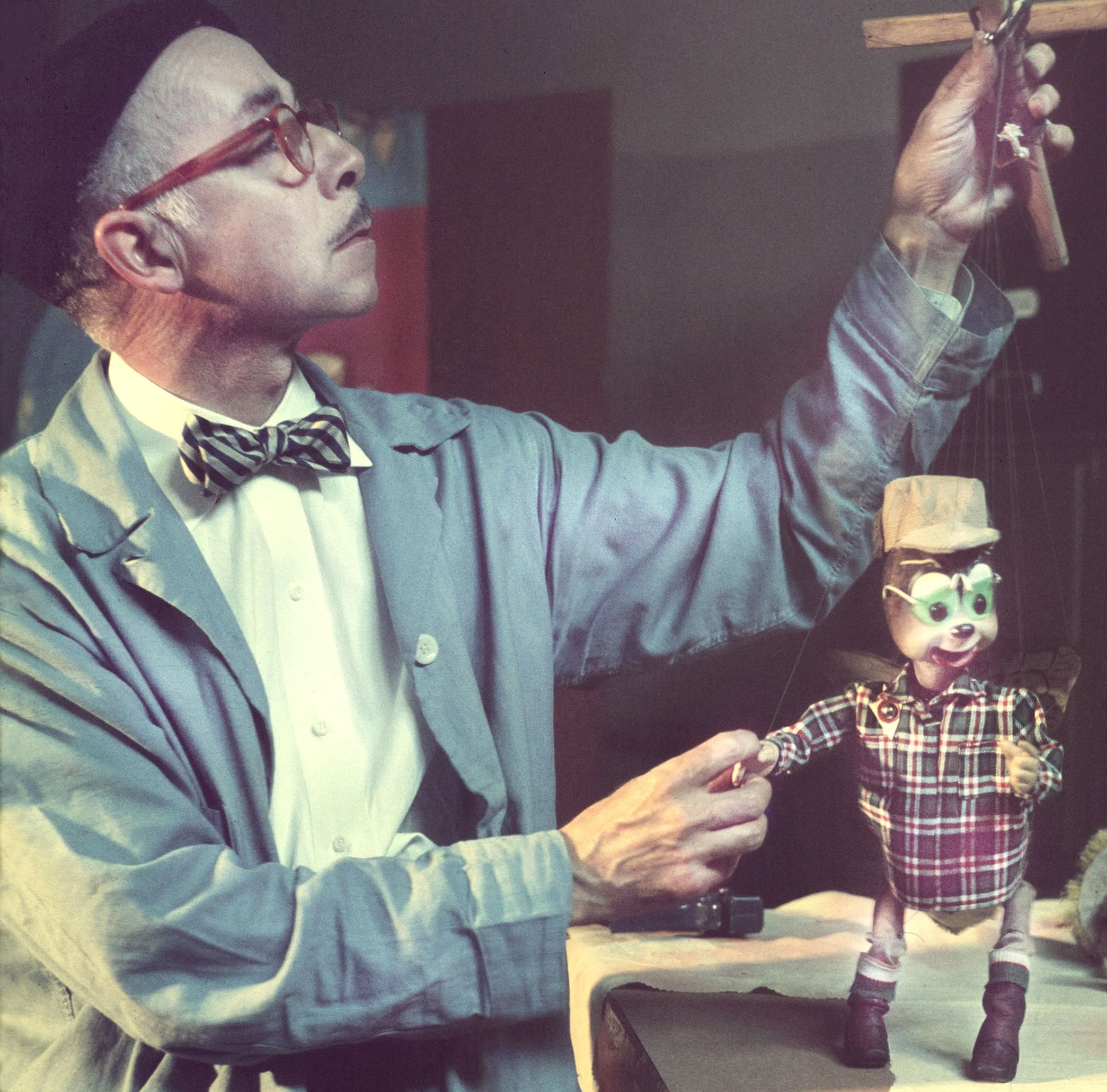
Family
1943
gouache and mixed media
5 × 7 inches
signed and dated
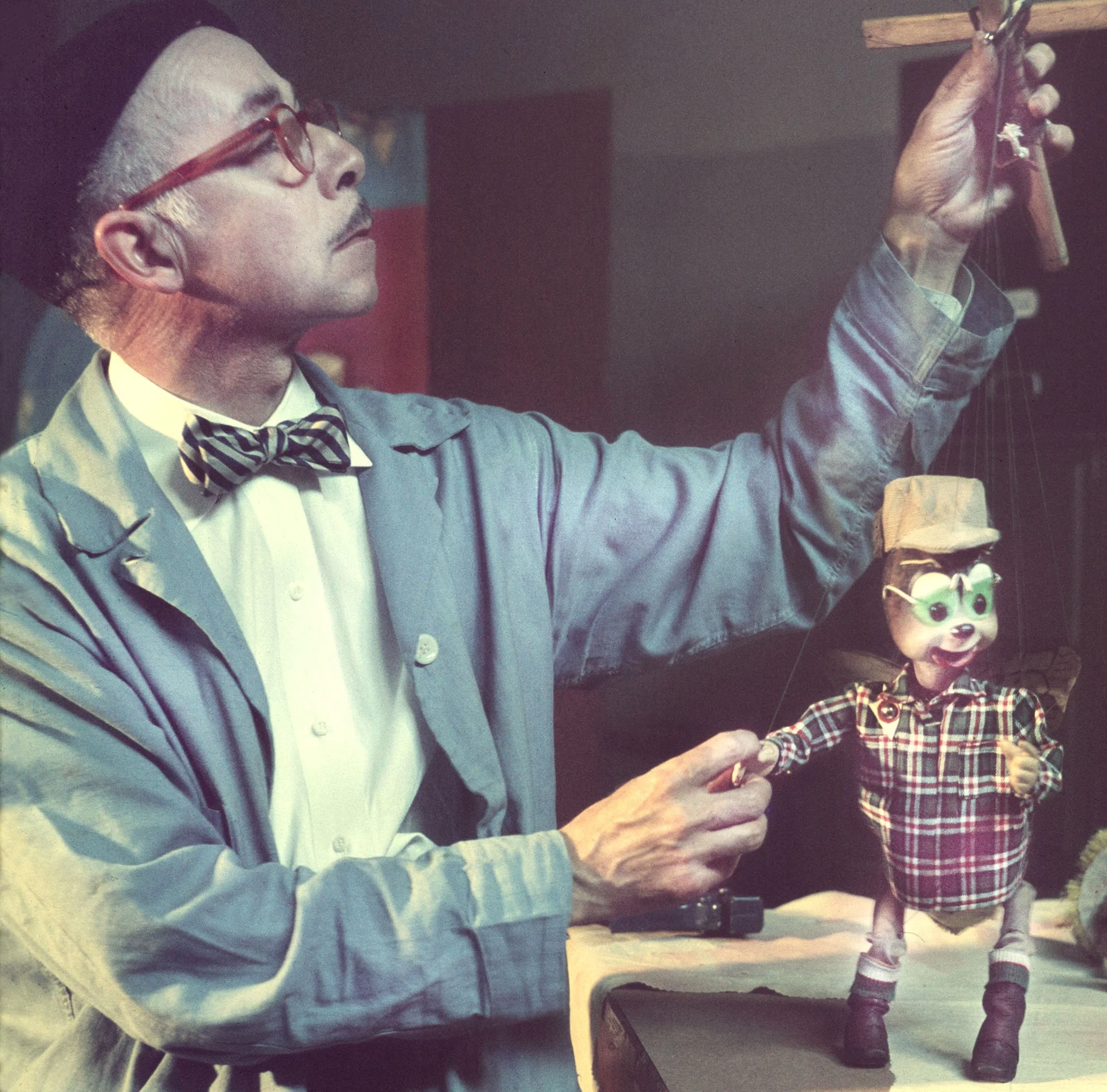
Ralph Chessé with his Brother Buzz puppet, year unknown. (Courtesy of the Chessé family)
Ralph Alexander Chessé (1900–1991) was a remarkably versatile painter, printmaker, muralist, sculptor, actor, and puppeteer whose career encompassed nearly the entire twentieth century. Born in New Orleans into a Louisiana Creole family of African and French ancestry, Chessé began painting as a teenager. Although he briefly attended the School of the Art Institute of Chicago in 1918–19, he was largely self-taught. After returning to New Orleans, he worked as an actor, stage manager, makeup artist, and scenic assistant at Le Petit Théâtre du Vieux Carré. He exhibited his paintings there as early as 1920.
Chessé arrived in California in 1923 and settled in San Francisco during the latter half of the decade. In 1925, artist and theatrical designer Blanding Sloan introduced him to puppetry, an encounter that profoundly expanded his creative practice. Chessé subsequently established the Marionette Guild and mounted ambitious productions of Shakespeare, Molière, and Eugene O’Neill, including Hamlet, Macbeth, and The Emperor Jones. He continued painting throughout these theatrical activities. In 1928, he shared the San Francisco Art Association’s second Anne Bremer Prize with painter Matthew Barnes, providing important early recognition of his work.
In 1934, Chessé was among the artists selected through the federal Public Works of Art Project to create the landmark murals inside San Francisco’s Coit Tower. His fresco, Children at Play, occupies a narrow, curved wall at the head of the second-floor stairs. Chessé arranged the children vertically around the playground equipment, giving each figure a distinct place within the composition. Their frontal poses, simplified forms, and suspended gestures anticipate qualities that recur throughout his figurative work.
Theater and puppetry appear to have shaped Chessé’s approach to narrative painting. His figures frequently occupy shallow, stage-like spaces, arranged as though they were actors or marionettes within a carefully constructed scene. Rather than capturing an instantaneous action, Chessé often held his figures in a state of deliberate stillness. In paintings such as Moses and the Idolaters and Canaan, both dating from approximately 1943, biblical narratives become contemplative tableaux. The viewer is invited to study the relationships among the figures and the symbolic meaning of the scene rather than follow a rapidly unfolding event.
During the 1930s, Chessé became director of puppetry for the California division of the Federal Theatre Project, organizing companies and designing productions in San Francisco and Los Angeles. He also presented marionette performances at the 1939 Golden Gate International Exposition. After the Federal Theatre Project ended, he worked with the WPA Federal Art Project’s graphic-arts division, where he learned screenprinting. During World War II, he worked at the Marinship shipyard in Sausalito while continuing to paint.
Much of Chessé’s work of the 1940s depicts Black families, laborers, dockworkers, and biblical figures. These subjects drew upon memories of New Orleans and reflected an African American heritage that was seldom publicly acknowledged during his lifetime. His compositions combined Social Realist subject matter with elements of Cubism and Expressionism. Later, the success of his award-winning children’s television program, The Wonderful World of Brother Buzz, which aired from 1953 to 1969, allowed Chessé to travel extensively. Encounters with European art, particularly French Fauvism, encouraged an increasingly expressive use of color. Although his style became freer and more abstract, the human figure remained central to his work.
Chessé exhibited at the Gildea and Lucien Labaudt galleries in San Francisco, the Duncan Gallery in New York, and the Marc Antony Gallery in New Orleans. His paintings also appeared at the Oakland Art Gallery and the de Young Museum, and he received a one-person exhibition at the San Francisco Museum of Art, now SFMOMA, in 1944. He moved to Ashland, Oregon, in the early 1980s and continued painting, expanding his subjects to include the Oregon landscape, until his death at the age of ninety-one.
Chessé’s work is represented in the collections of the Portland Art Museum and the Detroit Institute of Arts, which holds both his WPA prints and an important group of his marionettes. Recent exhibitions have renewed attention to his multifaceted career, including a solo presentation at the Georgia Museum of Art in 2015, Black Artists of Oregon at the Portland Art Museum in 2023–24, and the retrospective Ralph Chessé: A San Francisco Century at the San Francisco Public Library in 2024.
Ref: Oral history interview of Ralph Chessé, 1964 October 22. Archives of American Art, Smithsonian Institution.