Wadsworth Jarrell
(b. 1929)
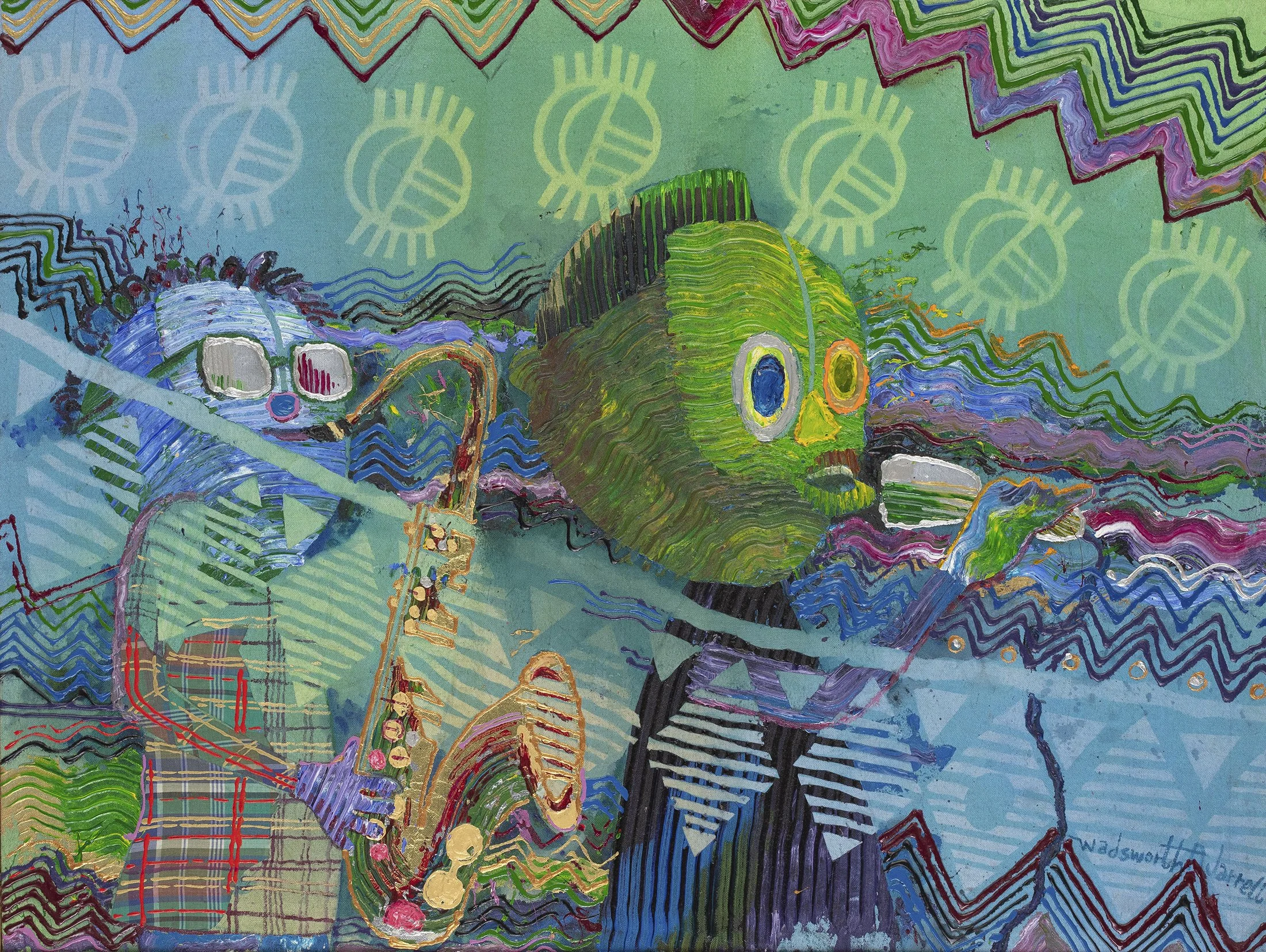
Blue Lou (Lou Rawls)
c. 1980
acrylic on canvas
27-1/2 x 36-1/2 inches
signed
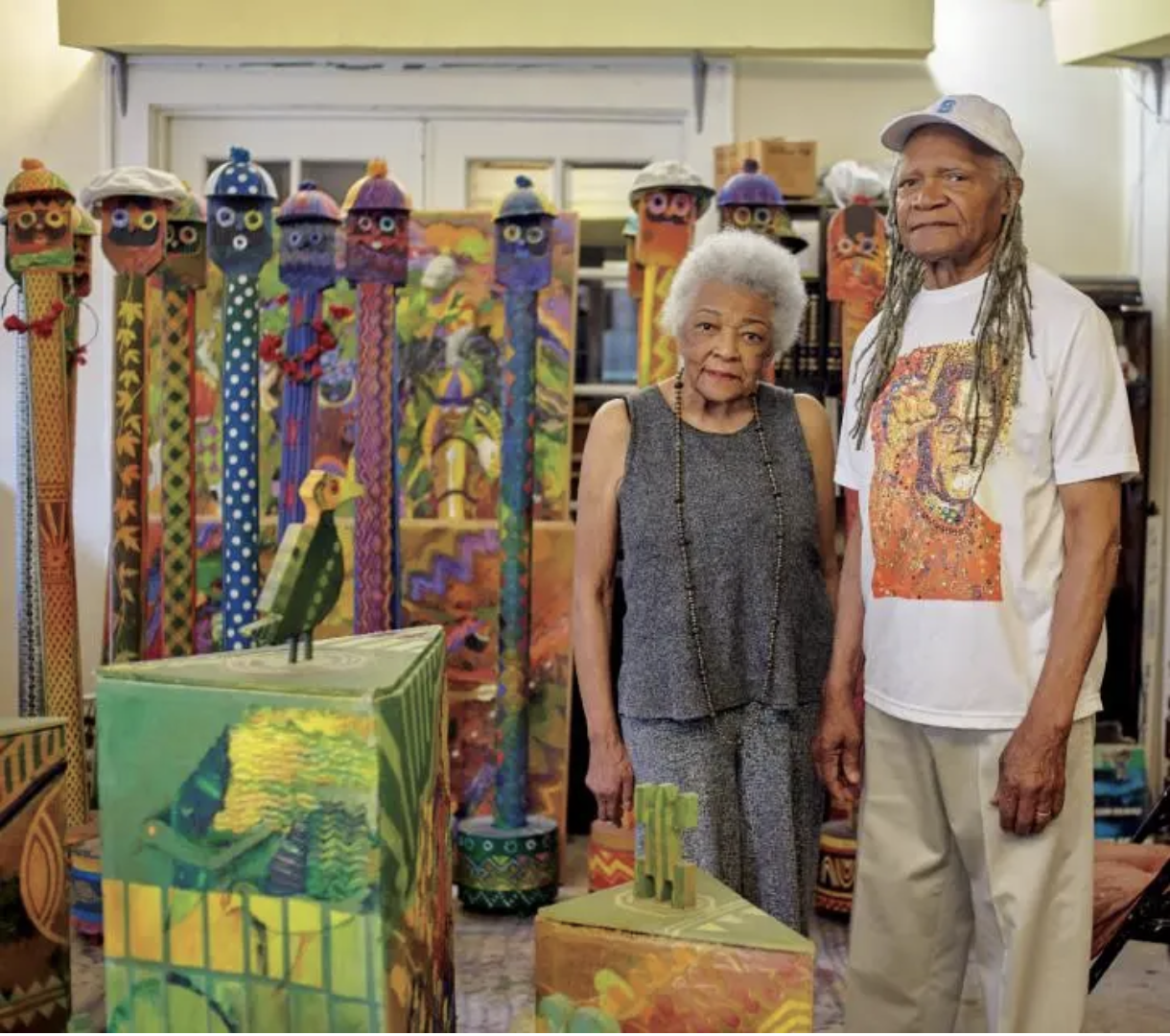
Wadsworth Jarrell is a painter, sculptor, and printmaker whose vibrant compositions unite music, African cultural traditions, and the political aspirations of Black America. A founding member of AFRICOBRA, he helped develop one of the most distinctive visual languages of the Black Arts Movement, bringing together brilliant color, rhythmic pattern, expressive figures, and lettering to create images of affirmation and collective possibility.
Born in Albany, Georgia, in 1929, Jarrell grew up in Athens, where his family encouraged his early interest in art. His father, a furniture maker, offered an example of craftsmanship that Jarrell understood as an artistic practice. After high school, he enlisted in the U.S. Army, producing signs, maps, and charts as a company artist and serving part of his enlistment in Korea. Returning to civilian life, he settled in Chicago and attended the School of the Art Institute of Chicago from 1954 to 1958.
Chicago’s South Side provided both subject matter and a community in which his art could develop. His early paintings explored everyday Black life, neighborhood gathering places, and the atmosphere of jazz and blues clubs. Music became an enduring source of inspiration, informing not only his subjects but also the movement, texture, and structure of his compositions.
During the 1960s, Jarrell became involved with the Organization of Black American Culture (OBAC), whose artists sought to make art responsive to the experiences and aspirations of their communities. In 1967, he joined the collective effort to create Chicago’s Wall of Respect, a landmark mural celebrating Black cultural and political figures. His contribution focused on rhythm-and-blues performers, including James Brown, B.B. King, Billie Holiday, Muddy Waters, Aretha Franklin, and Dinah Washington. The mural helped inspire a broader movement of public art grounded in Black pride and community participation.
In the late 1960s, Jarrell and his wife, artist and designer Jae Jarrell, opened WJ Studio and Gallery, a gathering place for visual artists, poets, and musicians. In 1968, the couple joined Jeff Donaldson, Barbara Jones-Hogu, and Gerald Williams in founding the collective that became AFRICOBRA—the African Commune of Bad Relevant Artists. Initially known as COBRA, the group expanded its outlook to embrace connections among Black communities throughout the African diaspora.
AFRICOBRA’s members sought to create art that communicated directly with Black audiences, affirmed cultural identity, and offered a vision of social transformation. Their shared aesthetic emphasized luminous “Cool-Ade” colors, strong patterns, positive imagery, and words integrated into the composition. In Jarrell’s work, these principles became a dynamic interplay of figures, marks, and color. His portraits of political leaders and musicians transform individual subjects into expressions of collective energy.
Music is especially important to this approach. Repeated lines, concentrated passages of color, and shifting patterns suggest syncopation and improvisation, translating the experience of listening into a visual language. In the illustrated work, saxophonists, a masklike face, and overlapping waves of color create a composition that appears to pulse with sound. Its interplay of recognizable imagery and abstraction reflects Jarrell’s ability to make cultural meaning inseparable from formal invention.
Jarrell also extended his influence through teaching at Howard University, the University of Georgia, and Spelman College. His participation in FESTAC ’77 in Lagos, Nigeria, strengthened the international dimension of his practice. In 2020, Duke University Press published his AFRICOBRA: Experimental Art toward a School of Thought, a firsthand account of the collective’s formation, exhibitions, and artistic philosophy.
His work has received sustained attention through exhibitions including, Soul of a Nation: Art in the Age of Black Power and AFRICOBRA: Nation Time, an official collateral event of the 2019 Venice Biennale. More recent presentations include Edges of Ailey at the Whitney Museum of American Art (2024–2025), the solo exhibition Somethin’ Else at Jenkins Johnson Gallery in New York (2026), and Wadsworth & Jae Jarrell: Art Making / World Making at the Albany Museum of Art, January 22–May 2, 2026. The Albany exhibition marked a homecoming to his birthplace while examining the couple’s enduring commitment to cultural visibility and artistic experimentation.
Jarrell’s work is represented in major public collections, including the Museum of Modern Art, the Whitney Museum of American Art, the National Museum of African American History and Culture, the Cleveland Museum of Art, and the Studio Museum in Harlem. Across his career, he has demonstrated how art can preserve cultural memory, celebrate Black creativity, and give visual form to the pursuit of freedom.