Harlan Jackson
(1918-1993)
Improvisation #13
1973
oil and collage on canvas
18 × 24 inches
signed; titled on stretcher verso
artist label with date and title, catalog #66
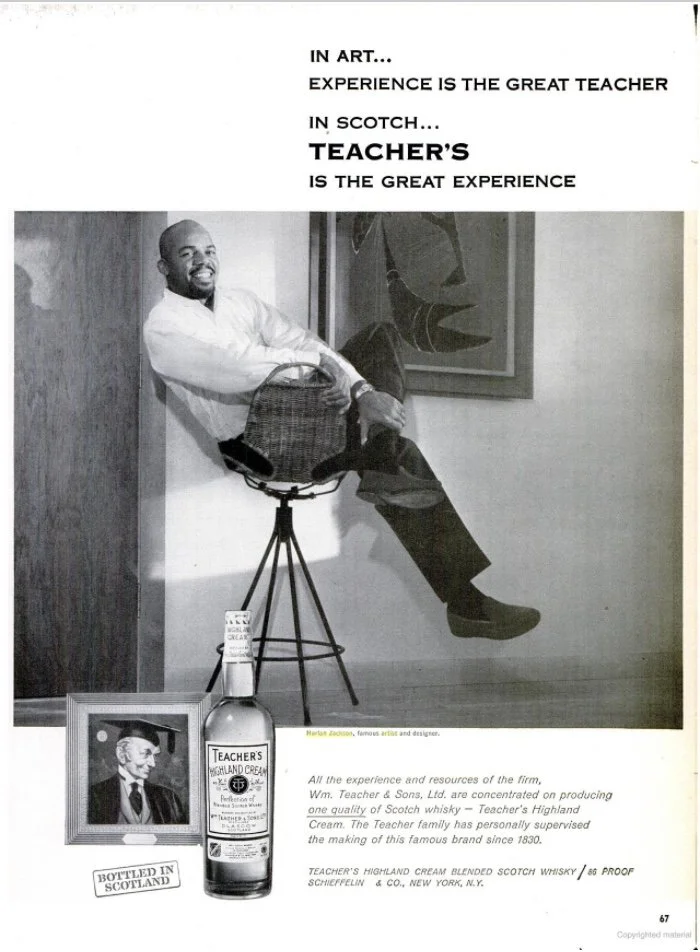
Harlan Jackson was an African American painter whose work brought together Abstract Expressionism, Cubist structure, and an enduring interest in African and Haitian cultural traditions. Born in Cleburne, Texas, in 1918, he later moved to Hutchinson, Kansas, and pursued studies in art at Kansas State Teachers College. Shortly before World War II, he returned to Texas and worked as a cartoonist for the Houston Informer. He served in the U.S. Navy during the war and afterward briefly played on a backup team associated with the Harlem Globetrotters. With support from the GI Bill, he resumed his artistic education.
Jackson enrolled at the California School of Fine Arts in San Francisco, where his teachers included Clyfford Still, Mark Rothko, Clay Spohn, and David Park. His classmates included John Grillo and James Keeney. Immersed in the city’s experimental artistic community, Jackson encountered bebop, modern dance, and avant-garde filmmaking, forms of expression that expanded his understanding of rhythm, movement, and abstraction.
The filmmaker Maya Deren and dancer and choreographer Katherine Dunham were particularly influential. Jackson also participated in Keeney’s experimental film The Cage (1947). With James Budd Dixon, he helped establish the North Beach Art Gallery, an artists’ cooperative. His first solo exhibition took place at the Artists Guild in 1947, and his work appeared in exhibitions sponsored by the San Francisco Art Association.
A Rosenberg Traveling Fellowship awarded in 1948 enabled Jackson to travel to Haiti, an experience that profoundly shaped his painting. There, he befriended Eldzier Cortor and renewed his acquaintance with Deren. His interest in Haitian Vodou and the persistence of African cultural traditions encouraged him to explore the relationship between spiritual experience, cultural identity, and abstract form. These concerns became central to his mask paintings, in which recognizable facial features emerge from fractured shapes, layered surfaces, and expressive passages of color.
Scholars have approached these paintings from complementary perspectives. In Abstract Expressionism: Other Politics, Ann Eden Gibson examines the tensions between Jackson’s Methodist upbringing and his engagement with Haitian spirituality. Richard J. Powell, in Black Art and Culture in the 20th Century, interprets Mask No. 11 (1949) in relation to Black cultural pride and participation in an art world that largely identified abstraction with white modernists. Read together, these interpretations illuminate Jackson’s effort to develop a personal artistic language capable of expressing both cultural inheritance and the possibilities of modern painting.
Jackson’s own account emphasizes that synthesis. In a 1975 statement, he described his longstanding effort to incorporate African designs and figures into Abstract Expressionism. His work thus offers an important perspective on the movement’s history, demonstrating how abstraction could carry specific cultural associations while remaining open to formal experimentation.
After his time in Haiti, Jackson continued his studies with Hans Hofmann and became involved in New York’s artistic community. He shared a studio with painter Lilly Fenichel and frequented the Cedar Tavern, a gathering place for artists associated with Abstract Expressionism. He and his wife, Jaki, later settled on Long Island’s East End. Jackson continued to develop his experimental painting through the mid-1970s, exhibiting at venues including the Barnett Aden Gallery, Panoras Gallery, and Acts of Art, where he had a solo exhibition in 1975. He died in 1993.
Subsequent exhibitions have brought renewed attention to his achievement. His paintings appeared in The Search for Freedom: African American Abstract Painting, 1945–1975 at Kenkeleba House in 1991. Reviewing that exhibition for The New York Times, Roberta Smith praised the tactile surfaces and compositional strength of his early mask paintings. Later presentations included Driven to Abstraction at the New York State Museum in 2006 and Abstraction + Abstraction at Kenkeleba House in 2010.
More recently, Jackson’s Untitled (Mask) (1950) was included in Spirit & Strength: Modern Art from Haiti at the National Gallery of Art, Washington, D.C., from September 29, 2024, through March 9, 2025. His work also appeared in Acts of Art in Greenwich Village at Hunter College’s Bertha and Karl Leubsdorf Gallery, November 7, 2024–March 29, 2025, which examined the influential Black-owned gallery’s history. These exhibitions place Jackson within broader accounts of African diasporic modernism and the institutions that supported Black artists.
Jackson’s work is represented in collections including Guild Hall, Howard University, the Schomburg Center for Research in Black Culture at the New York Public Library, and New York State’s Harlem Art Collection, which holds African Series Phoenix.