Lois Mailou Jones
(1905-1998)
Nice, France
c. 1950
watercolor on paper
19 x 24 inches
signed and titled
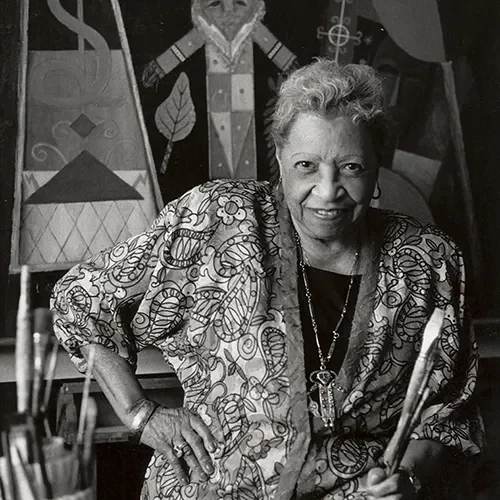
Loïs Mailou Jones was raised in Boston by working-class parents who instilled in her the values of education, discipline, and perseverance. After graduating from the School of the Museum of Fine Arts, Boston, she began her professional career designing textiles for firms in New York. Although successful, Jones grew frustrated by the anonymity imposed upon commercial designers and increasingly directed her ambitions toward the fine arts. In 1928, she accepted a teaching position at the Palmer Memorial Institute in Sedalia, North Carolina, where she founded the art department, coached basketball, taught folk dancing, and played piano for Sunday services. Two years later, she joined the faculty of Howard University in Washington, D.C. From 1930 until her retirement in 1977, she shaped generations of African American artists, including Elizabeth Catlett, David Driskell, and Sylvia Snowden.
A decisive turning point came during Jones’s first sabbatical from Howard in 1937–38, when a fellowship enabled her to study painting at the Académie Julian in Paris. There she worked within a rigorous academic environment while immersing herself in the city’s museums, galleries, cafés, and active community of artists. She befriended the French painter Céline Marie Tabary, who was initially assigned to serve as her translator and became a lifelong friend and artistic companion. Jones also received encouragement from the Post-Impressionist painter Émile Bernard and exhibited at the Société des Artistes Français and the Société des Artistes Indépendants.
France offered Jones something that remained largely unavailable to her in the segregated United States: the opportunity to be regarded first as an artist rather than primarily through the categories of race and gender. She painted throughout Paris, frequently setting up her easel directly in the streets and returning to the same location as changing light demanded. The experience strengthened her confidence and encouraged a freer, more immediate approach to color and observation. Paris also deepened her engagement with Impressionism and Post-Impressionism, particularly the structural landscapes of Paul Cézanne, while affirming landscape painting as an important and enduring part of her practice.
France was not merely a single formative episode. After travel was interrupted by World War II, Jones returned in 1947 and spent her summers there annually from 1946 through 1953, often working alongside Tabary and traveling beyond Paris into the French countryside and southern regions. The two watercolors presented here belong to this sustained engagement with the French landscape. In the hill-town view, Jones uses expansive, translucent washes to dissolve the surrounding countryside into shifting passages of green, blue, gray, and violet. Against this atmospheric setting, the steeply positioned stone building becomes a strong architectural anchor. The Nice harbor scene is more animated and linear: clustered boats, tilting masts, angular rooftops, and brightly colored reflections transform an observed coastal setting into an intricate rhythmic composition. Both works demonstrate Jones’s ability to balance spontaneity with underlying structure, a quality central to her mature watercolor technique.
Her time in Paris also brought her into closer contact with African art displayed in the city’s galleries and museums. This exposure contributed to works such as Les Fétiches of 1938, in which African masks became the basis for a distinctly modern composition. France therefore shaped two interconnected strands of Jones’s development: her sustained exploration of landscape and her increasingly confident engagement with African cultural forms.
In 1953, Jones married Haitian graphic designer Louis Vergniaud Pierre-Noël. Annual visits to Haiti introduced another important visual vocabulary, as she absorbed the island’s brilliant colors, architecture, spiritual traditions, and rhythmic patterning. In 1970, the United States Information Agency sent Jones to Africa as a cultural ambassador. Traveling through eleven countries, she lectured, interviewed artists, visited museums, and documented contemporary and traditional artistic practices. These experiences informed the African-inspired paintings of her later career, in which masks, textiles, symbols, and abstracted patterns converge.
Across more than seven decades, Jones developed an art grounded in travel, observation, and cultural exchange. France provided the crucial early experience of artistic freedom and international recognition; Haiti and Africa later expanded her visual language. Together, these encounters enabled Jones to create a body of work that was at once distinctly personal, cosmopolitan, and deeply connected to the cultural histories of the African diaspora.
St. Michelle, France
1958
watercolor on paper
18-1/2 x 23-1/2 inches
signed and titled
Selected Exhibitions
Howard University Gallery of Art, Washington, DC, 1937
Vose Galleries, Boston, MA, 1939, 1944
Morgan State College, Boston, MA, 1940
Exhibition of the Art of the American Negro (1851-1940); Tanner Art Galleries, Chicago, IL, 1940
National Academy of Design, NY, 1942, 1944, 1949, 1951, 1969
Exhibition of Paintings, Sculptures, and Prints by Negro Artists; Atlanta University, GA, 1942, 1944, 1949, 1952
Barnett Aden Gallery; Washington, DC, 1946
Howard University Gallery of Art, Washington, DC, 1948
Hampton Institute, VA, 1949
Galerie Soulanges, Paris, FR, 1966
The Evolution of Afro-American Artists; 1800-1950; City College, CUNY, NY, 1967
Smith-Mason Gallery of Art, Washington, DC, 1968
Paintings - Haiti-Paris by Lois Mailou Jones; Galerie Internationale, NY, 1968
LOIS MAILOU JONES: Retrospective exhibition, Forty Years of Painting, 1932-1972; Howard University Gallery of Art, Washington, DC, 1972
Acts of Art, Inc, NY, 1973
Reflective Moments: LOIS MAILOU JONES, Retrospective 1930-1972; Museum of the National Center of Afro-American Artists, Boston, MA, 1973.
Jubilee: Afro-American Artists on Afro-America; Museum of Fine Arts, Boston, MA, 1975
Two Centuries of Black American Art; Los Angeles County Museum of Art, CA, 1976
Musée d'art haïtien du Collège Saint-Pierre, Haiti, 1986
Unbroken Circle: Exhibition of African American Artists of the 1930's and 1940's; Kenkeleba House, NY, 1986
Narratives of African American Art and Identity: The David C. Driskell Collection; University of Maryland Art Gallery, College Park, MD, 1998
LOIS MAILOU JONES: Prints and Works on Paper; African American Museum in Philadelphia, PA, 2008
LOIS MAILOU JONES: A Life in Vibrant Color; Mint Museum of Art, Charlotte, NC, 2010
Full Spectrum: The Prolific Master within LOIS MAILOU JONES; D.C. Commission on the Arts, 2014-15
Black Refractions: Highlights from the Studio Museum in Harlem; NY, 2019-2021
Riffs and Relations: African American Artists and the European Modernist Tradition; The Phillips Collection, Washington, DC, 2020-2021; This exhibition explored the complex exchanges between African American artists and European modernism. Jones’s Place du Tertre (1938), painted during her first extended stay in Paris, was considered in relation to European painters such as Maurice Utrillo
The Harlem Renaissance and Transatlantic Modernism; Metropolitan Museum of Art, NY, 2024
Spirit & Strength: Modern Art from Haiti; National Gallery of Art, Washington, DC, 2024-25
Flight into Egypt: Black Artists and Ancient Egypt, 1876–Now; Metropolitan Museum of Art, NY 2024-25
Paris noir: Circulations artistiques et luttes anticoloniales, 1950–2000; Centre Pompidou, Paris, FR, 2025