John Tarrell Scott
(1940-2007)
Icarus, Lucifer's Fight
c. 1970
color collograph on wove paper
39 1/2 x 25 1/2 inches, full margins
signed, titled, and numbered, 4/10
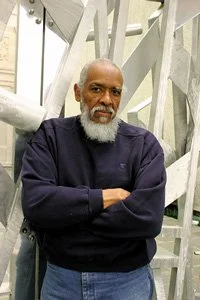
John T. Scott was a sculptor, printmaker, and educator whose art gave visual form to the cultural rhythms of New Orleans. Drawing on African and Caribbean traditions, jazz, and the city’s distinctive architecture, he developed a language of brilliant color, intricate line, and carefully balanced movement. His work joined formal experimentation with a deep awareness of history, making abstraction a means of exploring community, memory, and the persistence of Black cultural expression.
Born in New Orleans in 1940 and raised in the Lower Ninth Ward, Scott traced his earliest artistic education to learning embroidery from his mother. He earned a BA from Xavier University of Louisiana in 1962 and an MFA from Michigan State University in 1965, where he studied with painter Charles Pollock. Returning to New Orleans, he joined Xavier’s faculty and taught for more than forty years, mentoring generations of artists while developing his own increasingly ambitious practice.
Scott worked across sculpture, woodcut, painting, and mixed media, allowing ideas to move freely between two and three dimensions. In 1983, study with sculptor George Rickey encouraged his exploration of kinetic construction. Slender metal elements, suspended forms, and brightly painted components introduced actual movement into his work, creating changing relationships among line, color, and surrounding space. These sculptures invite an active encounter: their appearance shifts as their elements move and viewers change position.
Music was central to this approach. Scott treated jazz as a philosophy of improvisation and interconnectedness, translating its spirit into compositions that balance individual elements within a larger whole. His references encompassed the diddly bow, a string instrument associated with African American musical traditions, and the history of music and dance in New Orleans’s Congo Square. The resulting works suggest rhythm through repeated forms, intervals, and movement, connecting contemporary sculpture with cultural practices carried across generations.
His printmaking offered an equally powerful interpretation of place. In the monumental woodcuts of Blues Poem for the Urban Landscape, Scott crowded churches, corner stores, street signs, power lines, vegetation, and architectural details into densely organized compositions. Carving large plywood blocks with power saws and routing tools, he produced forceful lines and complex spatial relationships. These prints embody what he called “spherical thinking”, a way of considering past, present, and future simultaneously, and honor the African American artisans whose labor helped shape New Orleans.
A MacArthur Fellowship in 1992 helped Scott expand his studio and undertake larger public commissions. Among his most significant works is Spirit Gates (1994) at the New Orleans Museum of Art. Its elaborate aluminum structure recalls the city’s ironwork and musical traditions while carrying a broader symbolic meaning: created by a Black artist for a museum in formerly segregated City Park, the gates became an expression of welcome and cultural recognition.
Scott’s teaching reflected a similarly generous outlook. He embraced the philosophy of “pass it on,” believing that knowledge and opportunities gained should be shared with others. This principle informed his relationships with students and fellow artists and remains central to the mission of the Helis Foundation John Scott Center, which preserves and presents his work in New Orleans.
In 2005, the New Orleans Museum of Art presented Circle Dance: A John T. Scott Retrospective, surveying four decades of his career. Later that year, Hurricane Katrina displaced him from his home city; he died in Houston in 2007. His achievement continues to receive institutional attention, including NOMA’s John Scott: Blues Poem for the Urban Landscape, presented from May 21, 2024, through June 29, 2025. His work is held by institutions including NOMA, the Ogden Museum of Southern Art, and the Smithsonian American Art Museum. Through both his art and teaching, Scott left an enduring record of New Orleans’s cultural vitality and the creative possibilities of shared experience.