John Thomas Riddle, Jr.
(1933-2002)
Perfect Planning
1982
screen print
33 x 22 inches (image)
signed, dated, titled and numbered, and inscribed APC 2, Red Sky
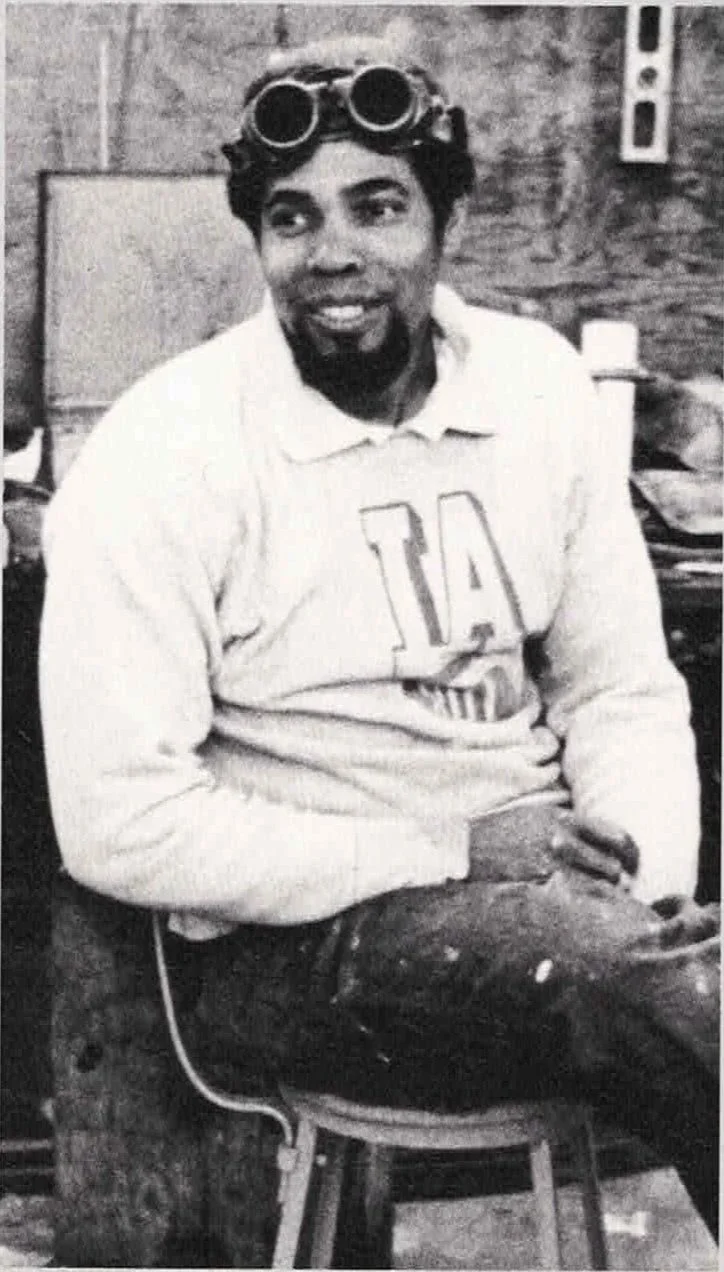
John T. Riddle, Jr. was a sculptor, painter, printmaker, and educator whose art addressed African American history, social injustice, and the possibilities of cultural renewal. Moving between found-object assemblage and vividly colored figurative compositions, he used materials and imagery to communicate ideas about struggle, dignity, and collective responsibility. His influence extended beyond his studio through teaching, public commissions, and leadership in the arts communities of Los Angeles and Atlanta.
Born in Los Angeles in 1933, Riddle earned an associate’s degree from Los Angeles City College before serving in the U.S. Air Force from 1953 to 1957. With support from the GI Bill, he continued his education at California State University, Los Angeles, receiving a bachelor’s degree in art education in 1966 and a master’s degree in fine art in 1973. During this period, he taught ceramics at Los Angeles High School and Beverly Hills High School. His first solo exhibition took place at Brockman Gallery in 1968.
The aftermath of the 1965 Watts uprising profoundly affected Riddle’s understanding of art’s social purpose. Introduced to Noah Purifoy through artist Ruth Waddy, he became part of a community that transformed discarded materials into compelling artistic statements. In Ghetto Merchant (1966), Riddle reconstructed a damaged cash register salvaged from the wreckage, mounting its exposed framework on scavenged metal legs. The sculpture preserves the history of its materials while achieving an expressive elegance through line, geometry, and open space. His relationships with artists including David Hammons and John Outterbridge further situated his practice within Los Angeles’s flourishing assemblage movement.
Riddle’s political concerns also encompassed war and its human consequences. His scrap-metal sculpture Gradual Troop Withdrawal (1970) depicts a soldier whose body progressively disintegrates toward an absent head. Its title turns the language of military policy into a forceful commentary on the Vietnam War, demonstrating his ability to unite material invention with a pointed conceptual message.
In 1974, Riddle moved to Atlanta to teach at Spelman College. He subsequently became executive director of the Neighborhood Arts Center and served for fifteen years as assistant director of the Atlanta Civic Center. His public sculpture Expelled Because of Color, installed on the Georgia State Capitol grounds, commemorates the thirty-three Black legislators expelled from the state’s General Assembly during Reconstruction. These activities joined his artistic practice to a broader commitment to public history and community access to the arts.
His paintings, prints, and relief constructions offered another means of communicating that commitment. Bold color, angular figures, repeated patterns, and integrated text made his compositions visually immediate while allowing historical and cultural references to accumulate. In the illustrated Perfect Planning (1982), patterned figures extend across a purple field beneath a brilliant yellow sky. The mirrored arrangement, pyramidal forms, and decorative border establish a carefully balanced structure. Lettering identifying “harmony & balance” and “God’s Creation” makes the relationship between visual order and spiritual meaning explicit, revealing an affirmative dimension of his art alongside its critical force.
Riddle’s dedication to younger artists was equally consequential. Through his ceramics teaching and leadership in the Tudor Arts youth program, he encouraged artists including Mark Steven Greenfield, Bret Price, and Joe Sims. Their subsequent careers attest to the reach of his mentorship. In 1999, he returned to Los Angeles as program manager of visual arts at the California African American Museum. He died in Atlanta in 2002.
Later exhibitions have continued to illuminate his achievement. His work appeared in Now Dig This! Art and Black Los Angeles 1960–1980 and the Broad’s 2019 presentation of Soul of a Nation: Art in the Age of Black Power. Also in 2019, Craft Contemporary organized The RIDDLE Effect, examining his three-dimensional work alongside that of artists within his circle. More recently, a work by Riddle appeared in Tall and Wild: Atlanta 1984–1994 at Atlanta Contemporary in 2025, reconnecting his art with the city’s cultural history.
His work is represented in collections including the Oakland Museum of California, the High Museum of Art, and the California African American Museum, as well as Georgia’s State Art Collection. Across these varied settings, Riddle’s legacy joins inventive artmaking with a sustained commitment to historical awareness, education, and Black cultural expression.