Bruce Onobrakpeya
(b. 1932)
Ekhena
Afieki I
1979
linocut print
9-1/4 x 6-3/4 inches (image), full margins (each same size)
signed, dated, titled, and numbered 163/250, and inscribed, Lagol
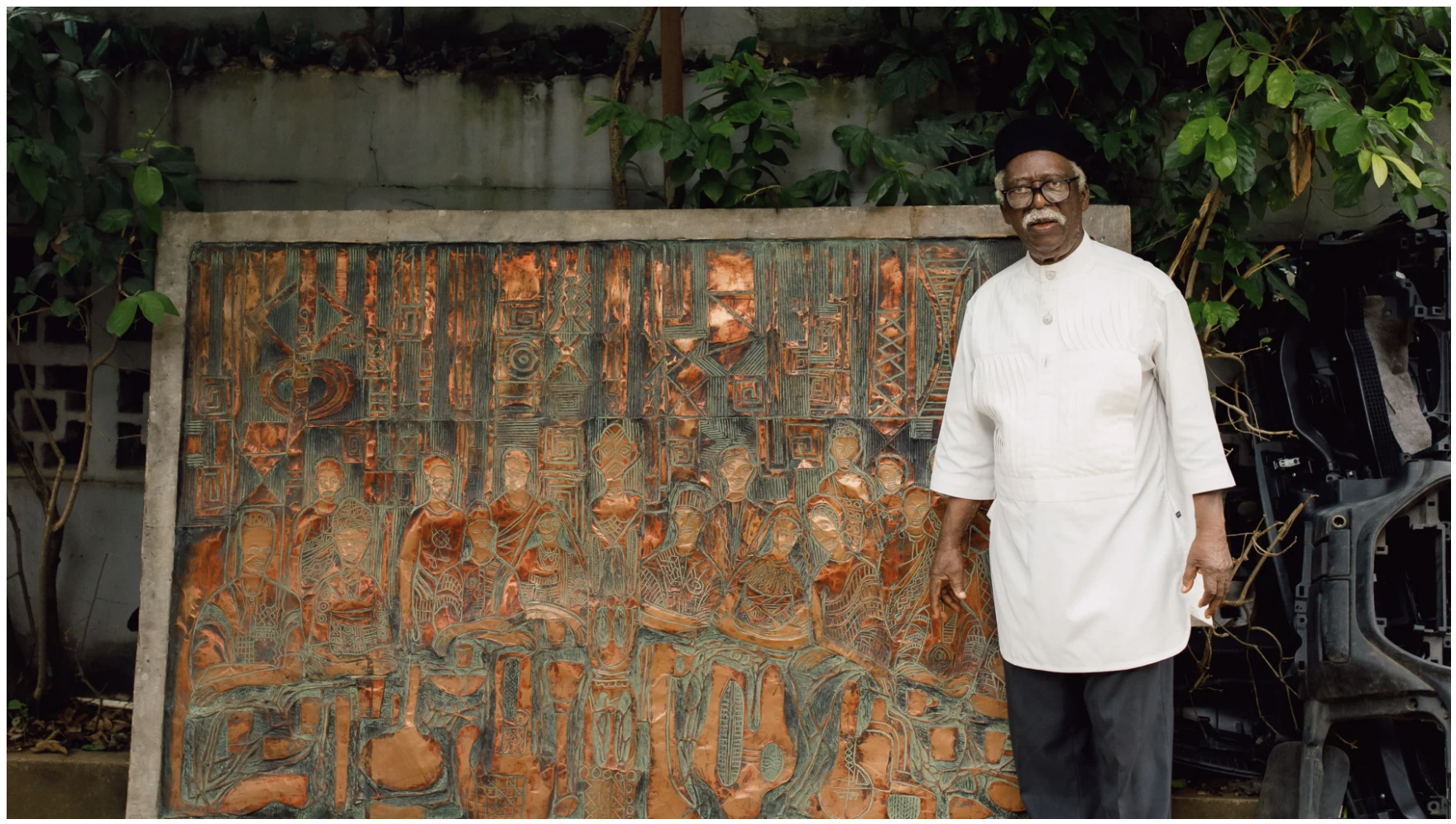
Manny Jefferson/for NPR
Nigerian printmaker, painter, sculptor, and educator Bruce Onobrakpeya is a foundational figure in modern African art. Across a career spanning more than six decades, he has brought Indigenous Nigerian traditions into dialogue with modernist experimentation, developing an expressive language grounded in storytelling, spirituality, and technical invention. His contributions extend beyond his own artwork to the training and encouragement of generations of artists.
Born in Agbarha-Otor, in present-day Delta State, Onobrakpeya grew up in an Urhobo family and spent much of his childhood in Benin City. His father was a carver, and his early surroundings introduced him to artistic traditions that would remain important throughout his life. In 1957, he began studying at the Nigerian College of Arts, Science, and Technology in Zaria, where an education based on European academic methods prompted him and his fellow students to reconsider the relationship between artistic training and their own cultural inheritance.
In 1958, Onobrakpeya became a founding member of the Zaria Art Society, alongside artists including Uche Okeke, Demas Nwoko, and Yusuf Grillo. Often called the “Zaria Rebels,” these artists advocated “natural synthesis”: an approach that combined African artistic traditions with selected Western techniques. Emerging around Nigeria’s independence in 1960, their philosophy helped establish a modern art grounded in Nigerian experience and cultural self-determination.
Although initially trained as a painter, Onobrakpeya found a particularly fertile medium in printmaking through workshops in Ibadan and Osogbo during the early 1960s. Experimentation became central to his practice, leading to deep etchings, additive plastographs, and plastocast reliefs. These processes expanded the relationship between printed imagery and sculptural surface. His work moves between recognizable figures and abstraction, drawing upon Nigerian folklore, masquerades, ancestral traditions, and the social tensions of contemporary life. Later installations inspired by Urhobo shrines incorporated his own reliefs alongside found and manufactured materials.
An important strand of his work explores the encounter between Nigerian spiritual traditions and Christianity. Beginning in the late 1960s, commissions for Catholic churches allowed him to reinterpret Biblical narratives through Nigerian figures, clothing, and settings. His Fourteen Stations of the Cross brought the Passion of Christ into a local cultural framework, while subsequent works continued to explore overlapping religious identities. Rather than treating inherited traditions as fixed, Onobrakpeya made their interaction a source of artistic invention.
Education has remained inseparable from his artistic career. He taught at St. Gregory’s College in Lagos from 1963 to 1980 and trained assistants and apprentices in his studio. In 1998, he established the Harmattan Workshop in Agbarha-Otor, creating a setting where established artists and beginners could work together across different media. Supported by the Bruce Onobrakpeya Foundation, the workshop extended his conviction that experimentation, exchange, and access to practical training are essential to artistic growth.
Recent exhibitions have further affirmed his international importance. Bruce Onobrakpeya: The Mask and the Cross, presented at Atlanta’s High Museum of Art in 2023, was his first solo exhibition at an American museum; it subsequently traveled to the Smithsonian’s National Museum of African Art in 2024–2025. His work also appeared in Tate Modern’s Nigerian Modernism exhibition in 2025–2026. Collections holding his work include Tate, the Smithsonian National Museum of African Art, and the High Museum of Art, preserving a legacy that encompasses both material innovation and the continuing vitality of Nigerian cultural traditions.