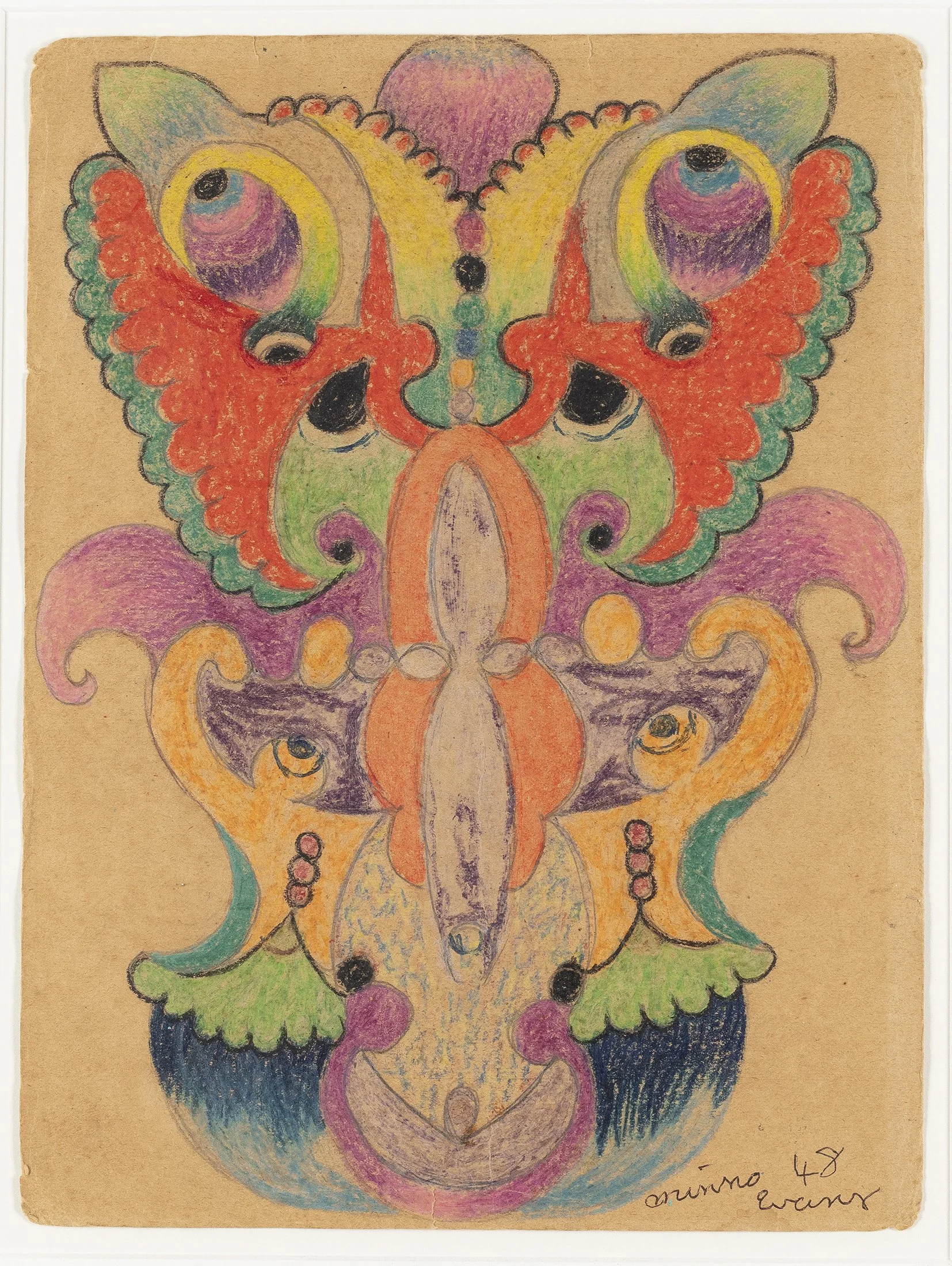
Minnie Evans
(1892-1987)
Untitled
1948
crayon on brown paper
12 x 9 inches
signed and dated
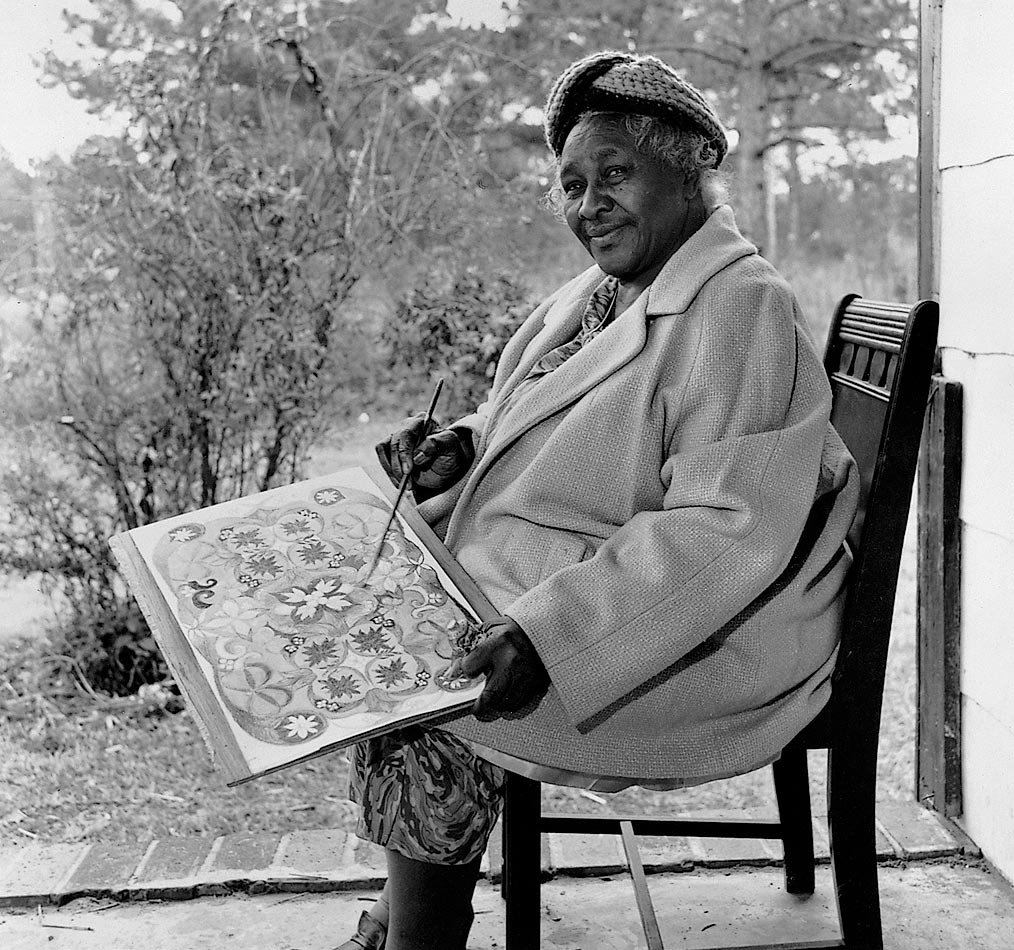
Minnie Evans created a world in which faces, flowers, and fantastic creatures merge into radiant expressions of spiritual life. Working without formal artistic training, she developed a distinctive language of symmetry, flowing line, and luminous color drawn from dreams, religious conviction, and her surroundings in coastal North Carolina. Born in Long Creek and raised in nearby Wilmington, Evans spent much of her life working and raising a family before gaining recognition as an artist. Her domestic employment on the estate that became Airlie Gardens exposed her to decorative objects and cultivated landscapes that would enrich her imaginative world.
Although Evans described vivid dreams and visions from childhood, she made her first drawings on Good Friday in 1935, responding to what she understood as a spiritual command. Art became a means of giving visible form to experiences she could not fully explain in words. She associated some of her imagery with a “lost world, civilizations preceding the biblical Flood, and regarded her work as a way of bringing that vanished realm into the present. Eyes recur throughout her compositions, sometimes within recognizable faces and sometimes floating among ornamental forms; for Evans, they could signify the watchful presence of God.
In 1948, Evans became the gatekeeper at Airlie Gardens, where she collected admissions and drew during quiet intervals. The gardens’ luxuriant vegetation offered a living counterpart to the abundance of her visions. Using crayons, colored pencils, ink, and paint, she brought botanical, human, and animal forms into intricate relationships. Symmetry often provides the underlying structure, while variations in color and detail keep the images animated and unpredictable. The familiar elements of nature become something extraordinary: leaves suggest wings, blossoms resemble eyes, and faces emerge from patterns that seem to grow across the page.
The work illustrated here exemplifies this fluid exchange between ornament and living form. Arranged around a central vertical axis, rounded shapes and curling contours suggest a fantastical presence without resolving into a single identifiable creature. Repeated eyes animate the design, while orange-red, green, violet, yellow, and blue establish a vibrant balance across the warm-toned sheet. Its near symmetry invites close comparison between the two sides, revealing small differences that give the composition its individual character. The image feels at once carefully ordered and continually transforming.
Evans initially shared her work with visitors to the gardens, selling or giving away drawings. Her relationship with photographer and advocate Nina Howell Starr helped bring it to a national audience, culminating in a solo exhibition at the Whitney Museum of American Art in 1975. Renewed attention to her achievement includes The Lost World: The Art of Minnie Evans, organized by the High Museum of Art in 2025 and presented at the Whitney in 2026–2027. Her drawings remain compelling for their ability to make private spiritual experience tangible through the simplest materials, joining intimate scale with an expansive vision of the world.