William Majors
(1930-1982)
Burning Bush
1967
etching
20-1/4 x 15-1/2 inches, full margins
signed, dated. titled and numbered, 34/110
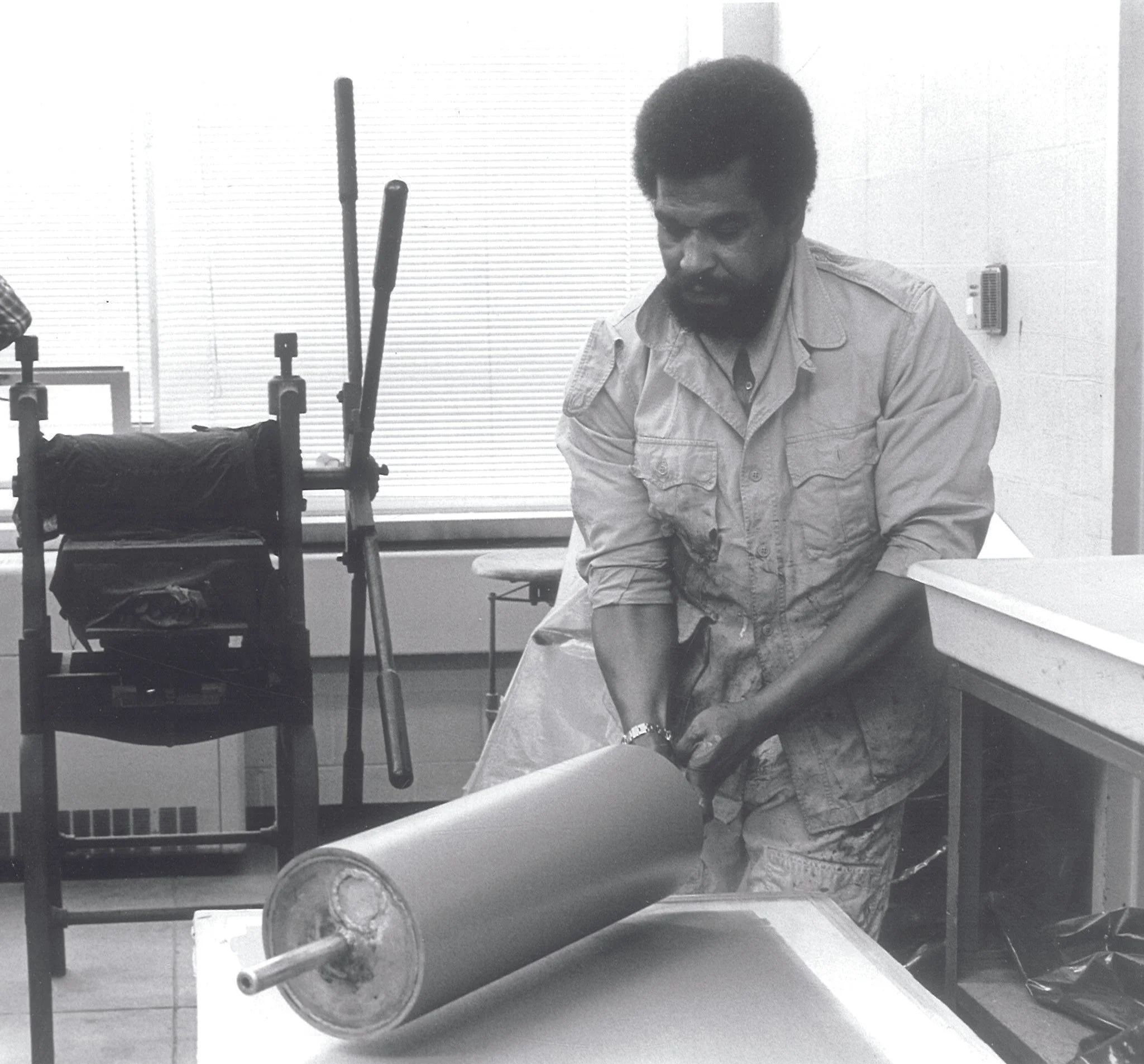
William Majors was a painter, printmaker, and educator whose work brought together expressive abstraction, organic forms, and a sustained interest in the spiritual dimensions of human experience. A member of the historic African American artists’ collective Spiral, he developed a personal visual language across paintings, drawings, collages, and prints. His imagery drew on the human body, the natural world, and biblical passages, transforming these sources into compositions that explore vulnerability, change, and the rhythms of life.
Born in Indianapolis in 1930, Majors began developing his artistic abilities during an extended hospitalization for tuberculosis as a teenager. Teacher Helen Mowray encouraged his education and drawing, helping establish a foundation for his later career. He subsequently studied at the John Herron Art Institute and the Cleveland School of Art. A John Hay Whitney Foundation fellowship supported a period in Florence, where firsthand encounters with Renaissance art became an enduring source of inspiration.
Majors settled in New York in the early 1960s, supporting himself through teaching and work as a security guard at the Museum of Modern Art. He became involved with Spiral, formed in 1963 as a forum for Black artists to discuss their relationship to the Civil Rights Movement and the changing cultural landscape. Working alongside artists including Romare Bearden, Norman Lewis, Emma Amos, and Hale Woodruff, Majors participated in a community that accommodated diverse artistic approaches while considering shared questions of identity, responsibility, and representation.
Printmaking became a particularly important avenue for his experimentation. His Etchings from Ecclesiastes (1965), a portfolio of eighteen prints published by MoMA’s Junior Council, brought him significant recognition. Accompanied by biblical passages selected with Susan Stedman, the prints employed etching, aquatint, sugar lift, and experimental methods of building texture on the printing plate. Their varied surfaces and intricate marks demonstrate his ability to make the technical processes of printmaking serve an expressive purpose. Majors printed, signed, and numbered the impressions himself.
The portfolio received the Grand Prize in Graphic Arts at the First World Festival of Negro Arts in Dakar, Senegal, in 1966, and was subsequently exhibited in the United States Pavilion at the 1970 Venice Biennale. Such recognition established Majors as an accomplished printmaker, even as he continued to work across other media. His practice joined disciplined craftsmanship with an openness to experimentation, allowing suggestive forms and abstract structures to carry meaning without depending on literal illustration.
Teaching remained integral to his career. Majors taught and lectured at institutions across the country, including Cornell University, the University of Iowa, the University of New Hampshire, Dartmouth College, and the Rhode Island School of Design. A Guggenheim Fellowship helped him equip his New Hampshire studio for painting and printmaking. He also acquired his own etching press and opened his studio to friends and colleagues, extending the spirit of exchange that informed his work as an educator. He died in Portsmouth, New Hampshire, in 1982.
Later exhibitions have brought renewed attention to his achievement. Brandywine Workshop and Archives presented Artist as Craftsman: Survey of Prints by William Majors in 2018. In 2026, the Shirley Fiterman Art Center at Borough of Manhattan Community College organized William Majors: Making a Mark, described by the institution as the largest survey of his art to date. On view September 9–December 19, 2026, the exhibition presents the complete Ecclesiastes portfolio and examines his printmaking within the artistic and cultural networks of the 1960s and 1970s.
Majors’ work is represented in collections including the Museum of Modern Art, the Metropolitan Museum of Art, the Delaware Art Museum, and the Indianapolis Museum of Art at Newfields. His legacy encompasses both technical innovation and a thoughtful exploration of abstraction’s capacity to express the complexity of human experience.
For more information on William Majors, please look at Black Art Auction’s publication on the artist.