Louis Sloan
(1932-2008)
Landscape
1974
oil on board
9-1/2 x 12 inches
signed and dated
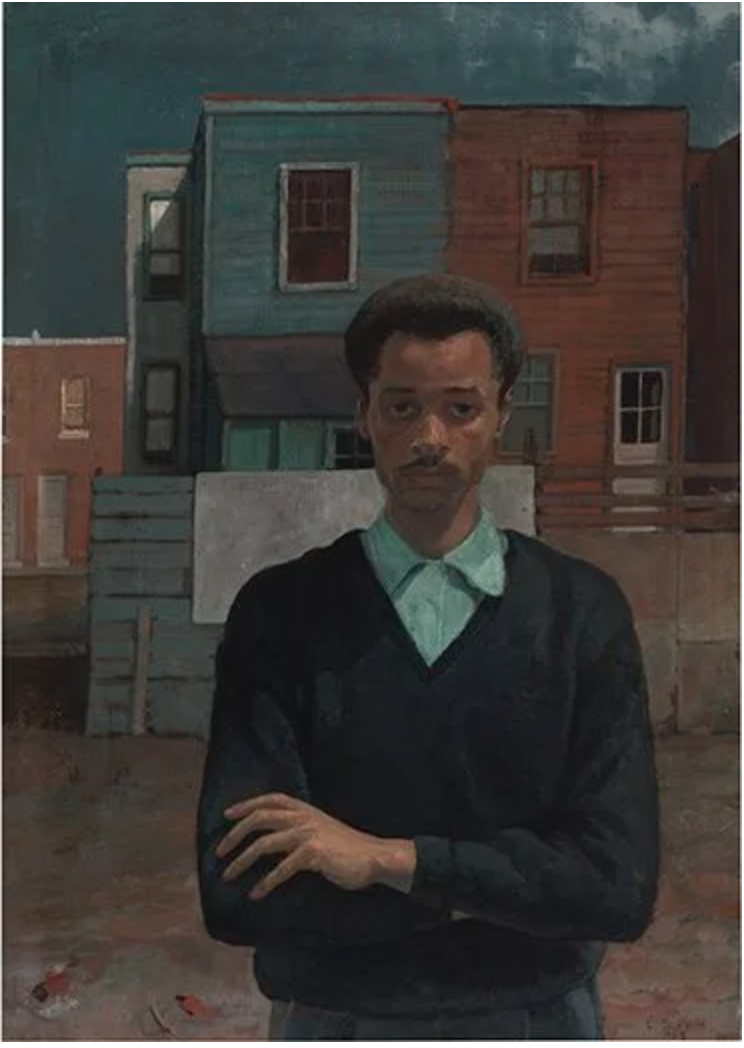
Louis Sloan, Self Portrait, 1956, oil on canvas
Painter, educator, and conservator Louis Baynard Sloan devoted his career to the expressive possibilities of the natural world. A central figure in Philadelphia’s artistic community, he painted wooded landscapes, waterways, changing skies, and neighborhood scenes with an attentive eye for light and atmosphere. His work combines recognizable places with vigorous brushwork, allowing the texture and movement of paint to convey the vitality of his surroundings.
Born in Philadelphia, Sloan received early training at the Samuel S. Fleisher Art Memorial. Artists Julius Bloch and Jack Bookbinder encouraged him to pursue further study at the Pennsylvania Academy of the Fine Arts, which he attended from 1953 to 1957. His instructors included Francis Speight and Hobson Pittman, whose teaching helped develop his interests in landscape and composition. A Cresson fellowship enabled him to travel to Europe, while a later Guggenheim fellowship supported travel within the United States, broadening the range of environments available to his painting.
Sloan’s subjects ranged from the backyards and streets of West Philadelphia to the mountains and forests of the northeastern United States. His early Backyards (1955), painted while he was a student, demonstrates his ability to discover pictorial interest close to home. Later works such as Lifting Fog in the Poconos (1980) and Frost Valley in the Catskills (1995) reflect his sustained fascination with the changing appearance of landscape. Across these paintings, weather, illumination, and seasonal color become integral to the experience of place.
The two paintings presented here reveal complementary aspects of that sensibility. In the wooded scene, dark, twisting branches spread across a pale sky, their irregular contours echoed by the energetic marks describing foliage and ground. Small accents of green, blue, and warm earth colors enliven the shadowed trees. In the waterfall painting, long strokes of white establish the downward movement of water against a richly worked surface of violet, brown, and green. Both pictures convey more than the appearance of a site: their brushwork gives the trees, rock, and water a palpable sense of movement and physical presence.
Sloan’s influence extended through decades of teaching. Returning to PAFA in 1962, he taught landscape, still life, portrait, and figure painting until his retirement in 1997. His students included Moe Brooker, Richard J. Watson, James Brantley, Edward Ellis Hughes, and Barkley L. Hendricks. Remembering Sloan, Hendricks described him as “a friend and a fantastic instructor,” a tribute to the personal encouragement that accompanied his technical instruction. Alongside teaching and painting, Sloan worked in the Philadelphia Museum of Art’s conservation department from 1961 to 1980.
His achievements were recognized through honors including a Louis Comfort Tiffany grant, an Emily Lowe grant, a Guggenheim fellowship, and the Brandywine Workshop’s James Van Der Zee Award. Following his death in 2008, PAFA presented Louis B. Sloan: A Particular Vision, a career survey curated by collector Lewis Tanner Moore.
Sloan’s work continues to receive attention through museum collections and exhibitions. His landscapes appeared in the Michener Art Museum’s 2025 exhibition Yesterday’s Dreams Are Real, devoted to Moore’s collection and legacy. His paintings are held by PAFA, the Philadelphia Museum of Art, Woodmere, and the African American Museum in Philadelphia. Together with the generations of artists he mentored, these works preserve his contribution to American landscape painting and Philadelphia’s cultural life.
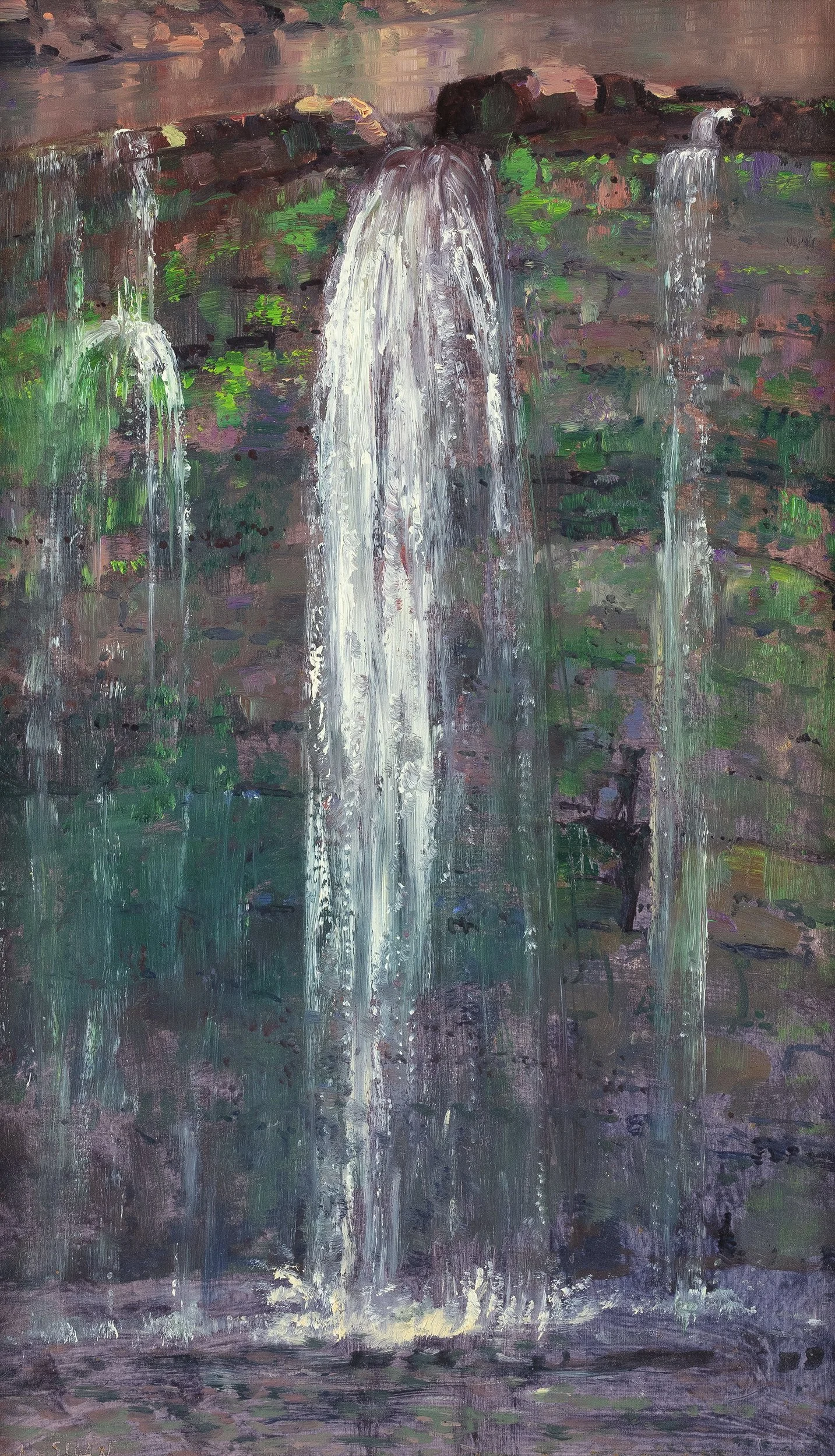
Waterfall
n.d.
oil on board
15 x 9 inches
signed