Howardena Pindell
(b. 1943)
Number Series #2
2003-2004
collage and etching
9 x 12 inches (image)
14-3/4 x 17-3/4 inches (sheet)
signed, dated, titled and numbered, 2/40
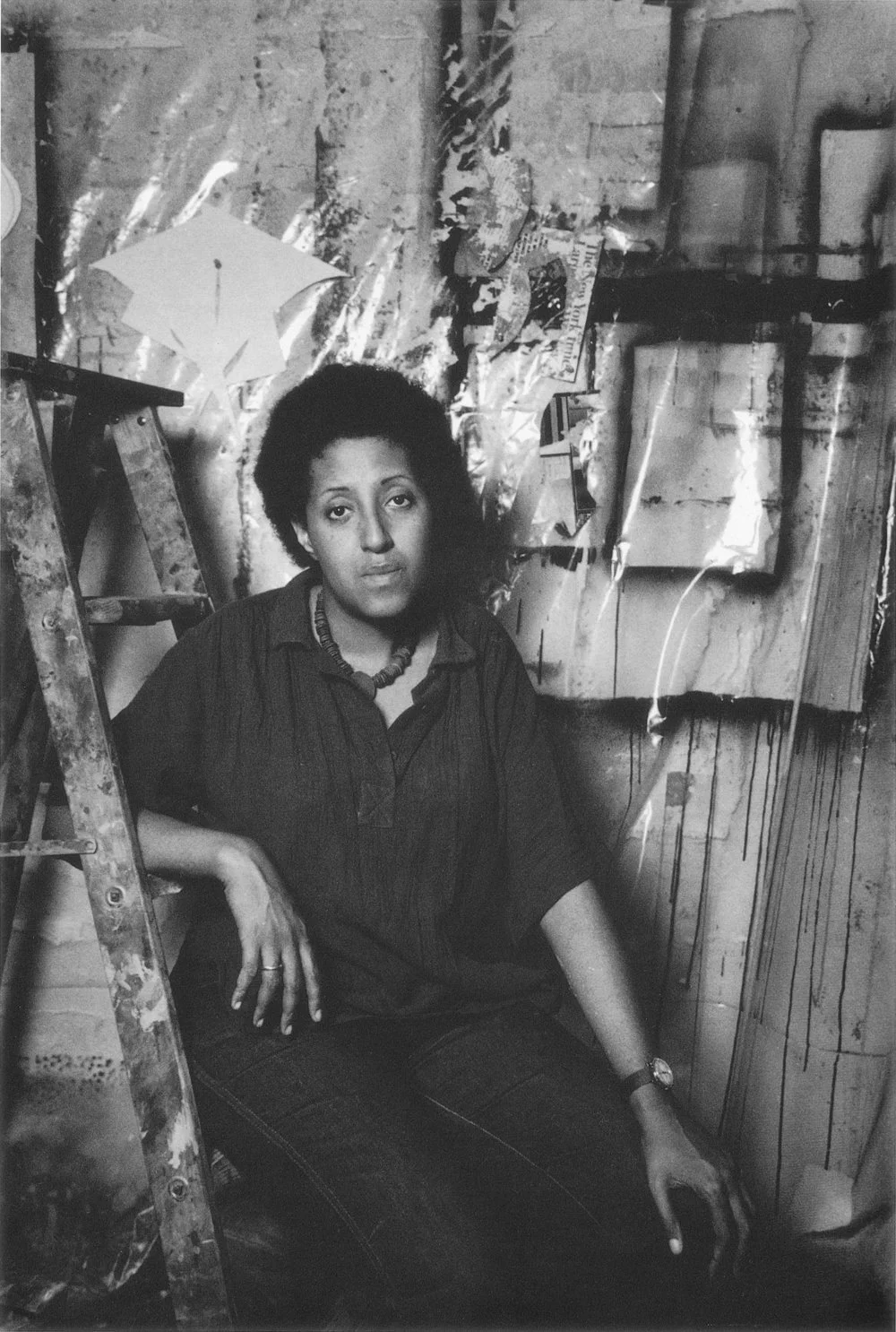
Howardena Pindell has developed an influential body of work that brings together abstraction, personal memory, and an unwavering commitment to social justice. Working across painting, drawing, printmaking, collage, and video, she explores how images and materials can register both individual experience and larger systems of meaning. Her recurring vocabulary of circles, numbers, arrows, and grids gives her work a distinctive visual language, joining meticulous observation with experimentation.
Born in Philadelphia in 1943, Pindell received her BFA from Boston University in 1965 and her MFA from Yale University in 1967. She subsequently joined the Museum of Modern Art in New York, where she worked for twelve years and advanced to associate curator. Her engagement with prints and illustrated books provided an important context for her own investigations of paper, layered imagery, and serial processes. In 1972, she helped establish A.I.R. Gallery, a pioneering cooperative created to provide exhibition opportunities for women artists. She began teaching at Stony Brook University in 1979, extending her influence through education as well as artistic practice.
During the 1970s, Pindell developed several interconnected approaches to abstraction. Alongside paintings and collages incorporating punched-paper circles, she made works in which handwritten numbers, directional arrows, and small geometric marks accumulated across the surface. These elements suggest notation, mapping, or the recording of movement, yet their shifting relationships encourage an open-ended experience of looking. Repetition establishes a rhythm, while changes in direction and density introduce uncertainty.
This vocabulary also informed her Video Drawings. Placing transparent sheets marked with arrows and numbers against a television screen, Pindell photographed the resulting combinations of drawing and broadcast imagery. These experiments brought together the handmade mark and the mediated image, creating layered visual fields in which several kinds of information coexist. Her prints carry related concerns into another medium, demonstrating the continuity of her investigations across drawing, photography, and printmaking.
The two works illustrated here exemplify this enduring interest. In the red composition, pale arrows, numerals, circles, and dots spread across a saturated field, creating currents of movement through variations in spacing and direction. In Constellations, luminous markings gather within a circular form against a dark ground, evoking a celestial map. The Metropolitan Museum of Art connects this imagery to Pindell’s fascination with star charts and astrological maps, noting that her arrows suggest multiple, sometimes contradictory directions. Together, the works reveal how a compact repertoire of signs can generate intricate relationships among order, chance, and perception.
A serious automobile accident in 1979 left Pindell with partial memory loss and encouraged a more explicitly autobiographical direction. Through photographs, text, and reconstructed surfaces, she explored recollection and identity. Her landmark video Free, White and 21 (1980) directly addresses racism and the dismissal of Black women’s experiences. Pindell’s sustained advocacy for marginalized artists also became integral to her work as a curator, educator, and writer.
Major exhibitions have emphasized the breadth of her achievement. Howardena Pindell: What Remains to Be Seen, organized by the Museum of Contemporary Art Chicago in 2018, surveyed her work across five decades. More recently, Deep Sea, Deep Space at White Cube Hong Kong (2024–2025) explored her continuing engagement with oceanic and cosmic imagery. Off the Grid at White Cube Bermondsey, London, November 21, 2025–January 18, 2026, examined her transformation of the grid across early works on paper, video, and large-scale paintings.
Pindell’s work is represented in major collections including the Museum of Modern Art, the Metropolitan Museum of Art, the Whitney Museum of American Art, the National Gallery of Art, and the Studio Museum in Harlem. Her art demonstrates how abstraction can hold personal and historical meaning, inviting viewers to discover connections through the patient examination of marks, patterns, and layered surfaces.
Constellations
2014
open bite etching in white on black wove paper
30 x 22 inches
signed, dated, titled, numbered, 39/100, blind stamp
Rather than striving for pure non-objectivity, Pindell combines abstraction with patterns and decorative elements such as numbers, arrows, and other personal references that reflect her influences (such as African art), life experiences, and political activism. Forms associated with Minimalist and Post-Minimalist art, such as grids and numbers, become endowed with personal meaning, as her father was a mathematician. Constellations was inspired by Pindell’s fascination with star charts and astrological maps. She began working with circles, dots, arrows, and vectors in the early 1970s. The arrows and vectors here suggest multiple, often contradictory directions and, by association, meanings. The circular form, a recurring shape in Pindell’s oeuvre, refers to the ability to shift negative experiences into something positive.
-from the Metropolitan Museum of Art, NY