Hale Aspacio Woodruff
(1900-1980)
The Jesters
n.d.
serigraph
5 x 7 inches, full margins
signed and titled
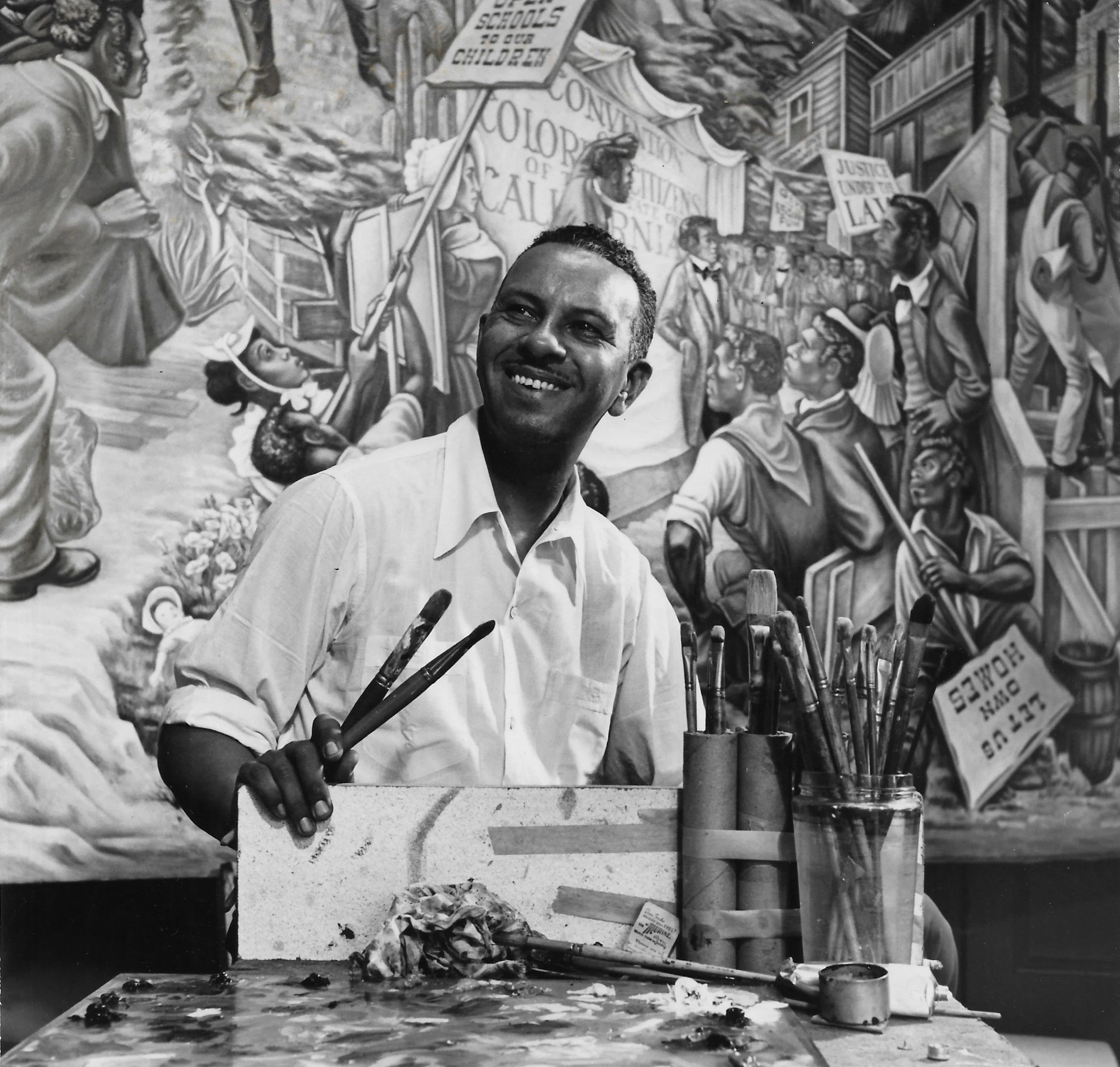
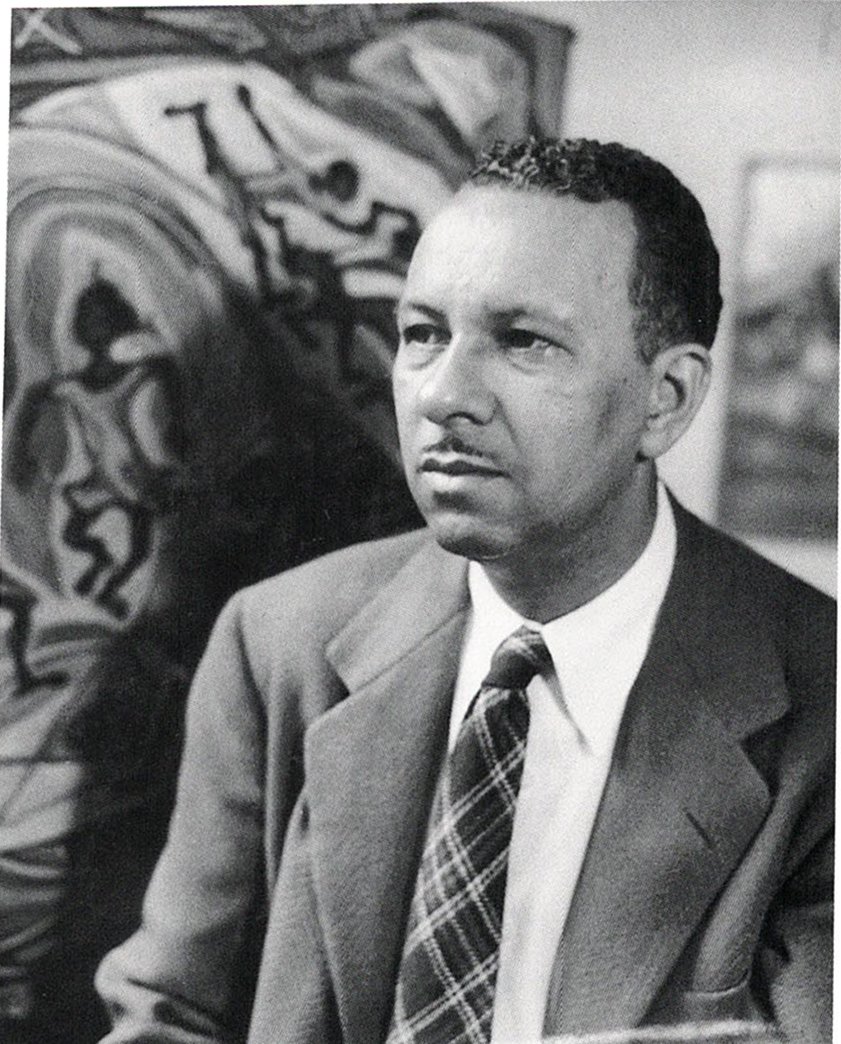
Hale Woodruff was a pioneering painter, printmaker, muralist, and educator whose career helped establish the foundations of African American modernism. Moving between social observation, historical narrative, and abstraction, he developed an artistic language informed by African art, European modernism, and Mexican mural painting. His importance extended beyond his own work: through teaching, exhibitions, and advocacy, he created opportunities for generations of Black artists.
Born in Cairo, Illinois, in 1900 and raised in Nashville, Tennessee, Woodruff received early encouragement from his mother, who drew in her spare time. He studied at the John Herron Art Institute in Indianapolis and briefly at the School of the Art Institute of Chicago. Recognition from the Harmon Foundation helped attract support for his move to Paris in 1927, where he remained until 1931. Studying at the Académie Scandinave and Académie Moderne, he encountered the work of Cézanne and the Cubists, met Henry Ossawa Tanner, and deepened his engagement with African art. These experiences encouraged him to develop a modernist approach grounded in his own cultural concerns.
Returning to the United States in 1931, Woodruff established an art program at Atlanta University and taught students across the affiliated colleges. Working within the limitations imposed by segregation, he combined rigorous instruction with an insistence on the significance of Black artistic achievement. In 1942, he founded the Atlanta University Art Annuals, providing a national exhibition and purchase-award program for African American artists. The annuals continued through 1970 and helped build the collection now held by Clark Atlanta University Art Museum.
Woodruff’s commitment to historical representation found monumental expression in his murals for Talladega College’s Savery Library. Commissioned in 1938, the six-panel cycle depicts the Amistad uprising and its aftermath alongside the Underground Railroad and the founding of Talladega. The Amistad panels were dedicated in 1939, followed by related Talladega scenes in 1940. Informed by his study with Diego Rivera in Mexico, these works present African Americans as active participants in the struggle for freedom and education. The original murals are now displayed in Talladega’s Dr. William R. Harvey Museum of Art.
After moving to New York in 1946, Woodruff taught at New York University for more than two decades. His paintings increasingly explored gestural abstraction, combining expressive color and brushwork with pictographic forms inspired by African sculpture and textile design. In 1963, he joined Charles Alston, Romare Bearden, and Norman Lewis in founding Spiral, a collective that considered the relationship between Black artistic practice and the Civil Rights Movement.
The illustrated print, The Jesters, demonstrates the lively exchange between abstraction and recognizable imagery in Woodruff’s work. Dark blue linear forms suggest animated figures against a brilliant yellow ground, while pale blue shapes connect and surround them. A long, perforated form across the upper register and an irregular green border establish a loose architectural framework. The composition’s rhythms emerge through repeated curves, angular gestures, and open spaces, allowing the figures to remain suggestive while giving the print a sense of collective movement.
Woodruff’s achievement continues to receive substantial attention. The High Museum of Art’s Rising Up: Hale Woodruff’s Murals at Talladega College opened in 2012 and traveled nationally following extensive conservation of the murals. More recently, his work appeared in The Harlem Renaissance and Transatlantic Modernism at the Metropolitan Museum of Art in 2024 and Acts of Art in Greenwich Village at Hunter College’s Bertha and Karl Leubsdorf Gallery in 2024–2025. These exhibitions illuminate his contributions across successive generations and artistic movements.
Woodruff died in New York in 1980. His legacy endures through his artworks, the institutions he helped strengthen, and his conviction that artistic experimentation and cultural responsibility could develop together.
Selected Exhibitions
HALE WOODRUFF; Pettis Galleries, IN, 1923 (first solo exhibition)
Negro in Art Week, exhibition of primitive African sculpture, modern paintings, sculpture, drawings, applied art, and books, Art Institute of Chicago, IL, 1927
Hale Woodruff; Atlanta University, GA, 1937
Exhibition of the Art of the American Negro (1851-1940), Tanner Art Galleries, Chicago, IL, 1940
HALE WOODRUFF: An Exhibition of Selected Drawings and Paintings; Morgan State University Art Gallery, Baltimore, MD, 1968
HALE WOODRUFF: An Exhibition of Paintings and Drawings; Acts of Art, Inc., NY, 1975
Two Centuries of Black American Art, Los Angeles County Museum of Art, CA, 1976
WPA and the Black Artist: Chicago and New York, Chicago Public Library, Il, 1978
Through A Master Printer: ROBERT BLACKBURN and the Printmaking Workshop, Columbia Museum of Art, SC, 1985
The Search for Freedom: African American Abstract Painting 1945-1975, Kenkeleba House, NY, 1991
A Shared Heritage: Art by Four African Americans, Indianapolis Museum of Art, INDIANAPOLIS, IN, 1996
Hale Woodruff: Paintings, Drawings, Prints, Studio Museum in Harlem, New York, NY, 2000
Challenge of the Modern: African American Artists, 1925-1946, Studio Museum of Harlem, NY, 2003
Rising Up: Hale Woodruff’s Murals at Talladega College, High Museum of Art, Atlanta, GA, 2012–14; traveling exhibition