Alvin D. Loving, Jr.
(1935-2005)
Crotch on Fire
1980
paint and torn paper collage on gray linen
52 x 52 inches
Al Loving expanded the possibilities of abstract painting through a sustained exploration of color, material, and space. His career moved from precisely constructed geometric canvases to exuberant arrangements of torn fabric and paper, transforming painting into an art of fragmentation, improvisation, and renewal. Across these changes, his work retained a distinctive vitality, with color serving as both structural force and expressive language.
Born in Detroit in 1935, Alvin Demar Loving, Jr. grew up in a household that valued education and creativity. His father was an educator and trained artist whose work included sign painting. Loving pursued his own artistic education in Michigan before earning a BFA from the University of Illinois in 1963 and an MFA from the University of Michigan in 1965. His early development was informed by teacher Al Mullen, through whom he encountered the ideas of Hans Hofmann, particularly the capacity of contrasting colors to suggest advancing and receding space.
In 1968, Loving moved to New York and became part of the artistic community surrounding the Chelsea Hotel. Recognition followed quickly: in December 1969, he became the first African American artist to have a solo exhibition at the Whitney Museum of American Art. His paintings of this period used cubes, hexagons, and interlocking geometric forms to create a tension between the physical flatness of the canvas and the illusion of three-dimensional space. Brilliant colors made these apparently orderly structures visually unstable, inviting the viewer to reconsider how space is perceived.
Despite this success, Loving increasingly found geometric painting restrictive. In the early 1970s, he began cutting and tearing canvases, then reassembling their fragments into irregular constructions. The Whitney’s 1971 exhibition Abstract Design in American Quilts, together with the example of Romare Bearden’s collages, helped encourage this transformation. Fabric offered a way to reconsider painting through processes of piecing, joining, and layering, while allowing the work to extend beyond the conventional rectangular frame. This change also intersected with his consideration of Black artistic identity and the forms it might take within abstraction.
His fabric constructions replaced the controlled illusionism of the earlier paintings with physical depth, exposed edges, and a more improvisational organization. By the late 1970s and into the 1980s, he extended these experiments into paper collage, coloring sheets before tearing and cutting them into strips, curves, and spirals. Overlapping fragments produced intricate relationships among color, light, and shadow. Loving described himself as a “material abstractionist,” and identified the recurring spiral as a symbol of life and continued growth.
The two illustrated works reflect this vocabulary of layered fragments and sweeping movement. Bands of blue and yellow intersect with black-and-white passages, while slender curves travel across the composition, binding its scattered elements together. Their closely related imagery also demonstrates how Loving’s collage language could translate into graphic form: the signed, numbered poster for the Raymond Johnson Dance Company connects his visual rhythms with the performing arts. The relationship between these particular works should be understood through their cataloged media and dates, but their shared composition clearly expresses his interest in movement and spatial complexity.
Loving taught at City College of New York from 1988 to 1996 and received a Guggenheim Fellowship in 1986, along with several National Endowment for the Arts fellowships. His career also included major public commissions, extending his investigations of color and form into architectural settings. He died in 2005.
Recent exhibitions have continued to illuminate the breadth of his achievement. Al Loving: Emperor’s Clothing at Garth Greenan Gallery in 2022 revisited his torn-canvas constructions of the 1970s. His work subsequently appeared in Electric Op at the Buffalo AKG Art Museum and Edges of Ailey at the Whitney Museum, both presented in 2024–2025. In 2026, his painting Janice (1970) was included in Revelation: A Journey into Abstraction at the Smithsonian’s National Museum of African American History and Culture. These presentations connect his work to overlapping histories of optical experimentation, performance, and Black abstraction.
Loving’s work is held by major institutions including the Whitney Museum of American Art, the Metropolitan Museum of Art, the Museum of Modern Art, the Detroit Institute of Arts, the Philadelphia Museum of Art, and the Studio Museum in Harlem. His legacy rests in the freedom with which he reimagined abstraction, making the construction of an artwork, its cutting, tearing, layering, and joining, central to its expressive power.
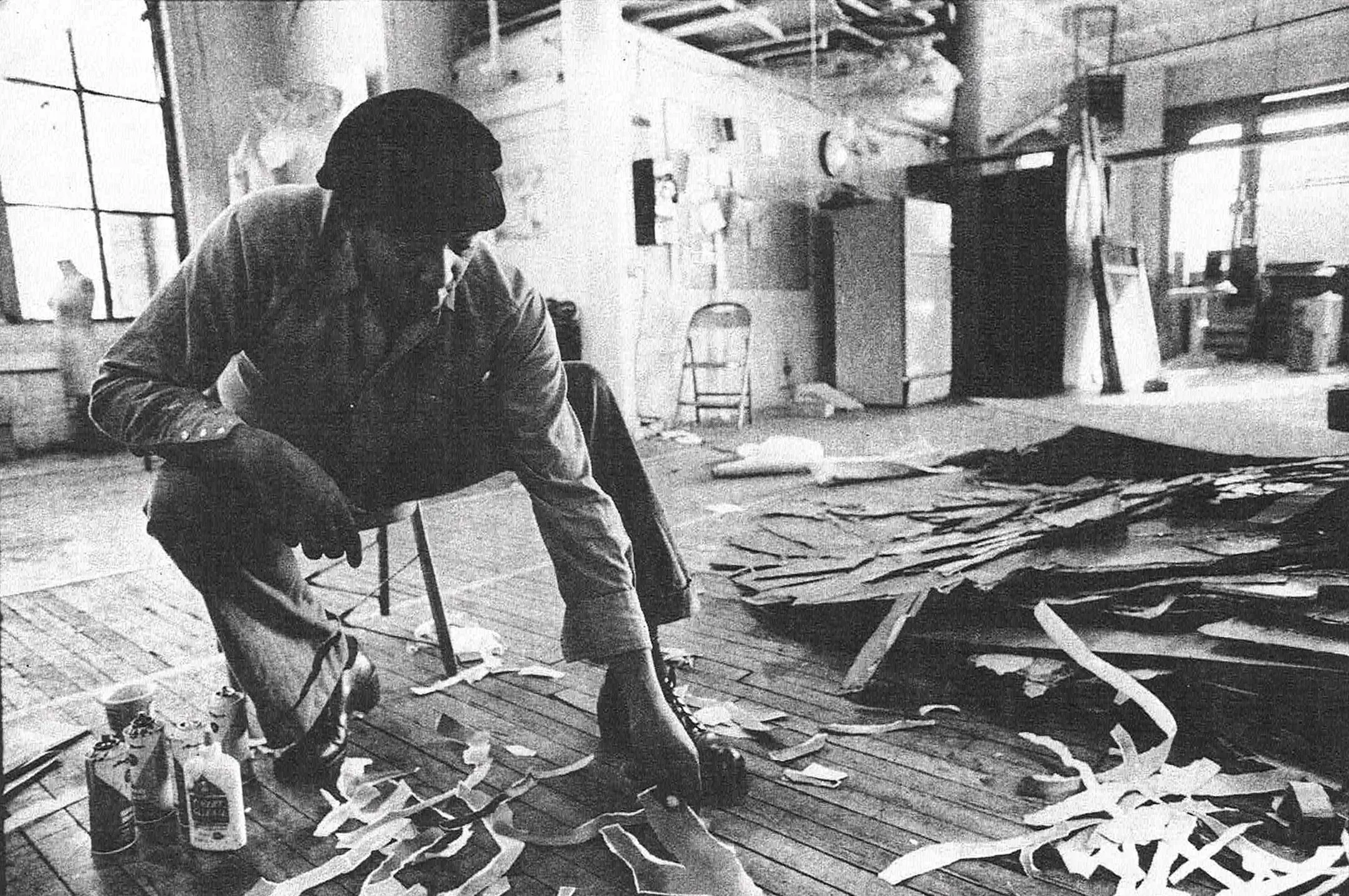
Al Loving in his studio from the article “Artists and the Fine Art of Survival”, Black Enterprise, December 1975; p. 22.
The Raymond Johnson Dance Company (Crotch on Fire)
1980
offset lithographic poster
30 x 24 inches
signed and numbered 87/200
The Raymond Johnson Dance Company was a modern dance troupe founded in 1974 by Black dancer and choreographer Raymond Johnson. Born in Harlem, Johnson trained at the Henry Street Playhouse and performed with the companies of Alwin Nikolais and Murray Louis before establishing his own ensemble. The company toured extensively until 1980, when a back injury forced Johnson to retire from performing and disband the troupe. Its photographs and papers are preserved in the New York Public Library’s Jerome Robbins Dance Division.