Richard Dempsey
(1909-1987)
Waterfront
1950
oil on canvas
20 x 24 inches
signed and dated
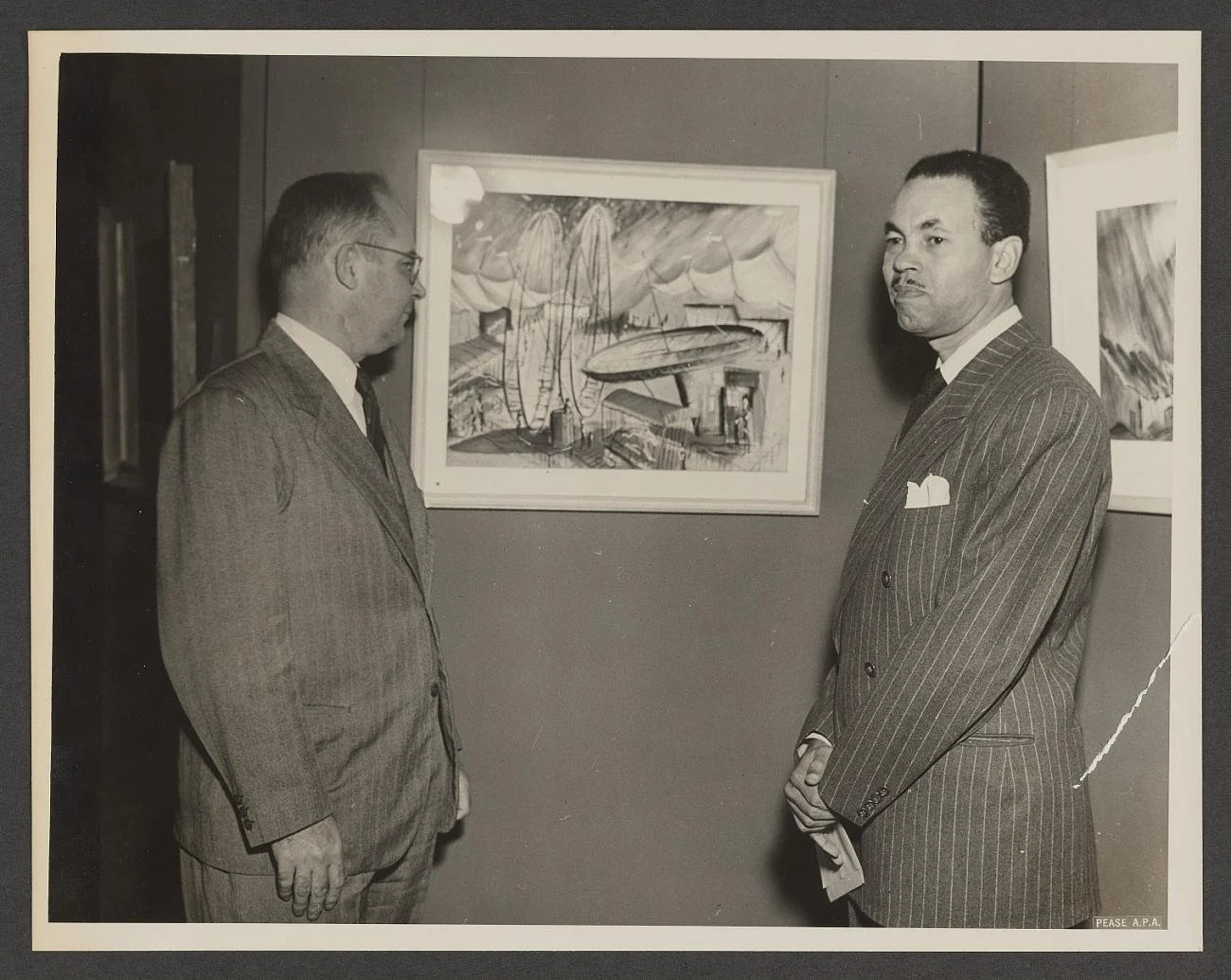
Richard Dempsey, pictured with Corcoran Gallery of Art director, Herman Williams in 1949, and Dempsey’s painting, Circus.
Richard Dempsey papers, 1929-1989, bulk 1960s-1980s. Archives of American Art, Smithsonian Institution..
Richard William Dempsey was an American painter, draftsman, illustrator, and educator whose career encompassed portraiture, social realism, landscape, and expressive abstraction. Born in Ogden, Utah, Dempsey spent his formative years in Oakland, California. He studied art at Sacramento Junior College in the early 1930s and continued his education at the California College of Arts and Crafts in Oakland from 1932 to 1934. He also attended the Students Art Center and studied sculpture with the prominent California artist Sargent Claude Johnson. By the time he left California, Dempsey had participated in four exhibitions, including an early solo presentation in Oakland.
In 1941, Dempsey moved to Washington, D.C., after accepting a position as an engineering draftsman with the Federal Power Commission. He subsequently worked as an illustrator for the General Services Administration, eventually supervising a staff of illustrators and completing a federal career of nearly thirty years. At the same time, he became an active participant in Washington’s artistic community. He pursued additional study at Howard University, including lithography with James Lesesne Wells, and later taught at the Corcoran School of Art and at the Glen Echo art program in Maryland.
Dempsey received national recognition in 1946 when he was awarded a Julius Rosenwald Fund fellowship to undertake an ambitious series of one hundred portraits of distinguished African Americans. Elizabeth Catlett was also among the artists awarded Rosenwald support that year, although the two artists pursued separate projects. Dempsey’s subjects included such prominent figures as Duke Ellington, Ethel Waters, Thurgood Marshall, Adam Clayton Powell Jr., Joe Louis, and Jacob Lawrence. The project united his skill as a draftsman with his interest in documenting Black achievement at a time when African American subjects remained significantly underrepresented in American portraiture.
Although portraiture established an important part of Dempsey’s reputation, his work was remarkably varied. His early paintings frequently depicted recognizable figures, streets, alleys, and backyards, including scenes observed in Southwest Washington. These compositions combined an awareness of social conditions with a strong sensitivity to color and design. By the late 1940s, he had begun moving toward abstraction, progressively transforming observed figures and landscapes into arrangements of interlocking shapes, agitated brushwork, and saturated color. His training in sculpture contributed to the sense of mass and structure found even in his most abstract compositions.
Dempsey was an energetic and intuitive painter. Accounts of his studio practice describe him working on as many as six canvases simultaneously, moving from one to another as his mood and ideas changed. This method encouraged the spontaneity visible in his mature work, while his continued attention to underlying structure prevented the paintings from becoming merely decorative. Although increasingly abstract, his art seldom lost its connection to people, places, and lived experience. During the civil-rights era, he also produced paintings responding to racial violence and social upheaval, including forceful compositions inspired by events in Selma and by the 1968 disturbances in Washington.
Travel became another important catalyst for Dempsey’s development. A 1951 journey to Haiti resulted in a group of paintings exhibited at Washington’s Barnett-Aden Gallery. Subsequent visits to Jamaica, Mexico, Colombia, and other locations in the Caribbean and Latin America provided new sources of color, rhythm, and imagery. In these works, houses, vegetation, shorelines, and human figures are often reduced to animated fields of color while remaining rooted in the character of a particular place. Several of Dempsey’s paintings circulated internationally for many years through the United States Department of State’s Art in Embassies program.
In 1951, Dempsey received a Purchase Award in the Corcoran Gallery of Art’s Tenth Annual Exhibition. His inclusion in the Barnett-Aden Gallery’s 1954 exhibition Abstractions: New York and Washington Artists placed his work within the broad, racially integrated field of abstraction emerging in the capital. For many years he was represented by Washington dealer Franz Bader, and in 1968 Howard University mounted a retrospective covering nearly two decades of his work. In 1983, he was included in the important exhibition Six Washington Masters, alongside Alma Thomas, Lois Mailou Jones, Delilah Pierce, James A. Porter, and James Lesesne Wells.
Dempsey remained productive until late in his life, creating paintings that ranged from intimate works on paper to vigorously brushed abstractions. Today his work is represented in the Smithsonian American Art Museum, the National Gallery of Art, The Phillips Collection, and the Art Bank Collection of the District of Columbia Commission on the Arts and Humanities.
Selected Exhibitions
Contemporary Painting: 32 Americans; Museum of Arts and Sciences, Norfolk, VA, 1949
Barnett Aden Gallery, Washington, DC, 1951 (solo)
Pan-American Union, Washington, DC, 1951 (solo)
Tenth Annual Exhibition of Paintings, Sculpture, and Prints by Negro Artists; Atlanta University, GA, 1951
10th Annual Exhibition of American Art; Corcoran Gallery of Art, Washington, DC, 1952
Franz Bader Gallery, Washington, DC, 1961, 1962,1974, 1983 (solo)
New Vistas in American Art; Howard University Gallery of Art, Washington, DC, 1961
Howard University Gallery of Art, Washington, DC, 1968 (solo)
Highlights from the Atlanta University Collection of Afro-American Art; High Museum of Art, Atlanta, GA, 1973
Six Washington Masters: Richard Dempsey, Lois Jones, Delilah Pierce, James Porter, Alma Thomas, James Wells; Evans-Tibbs Collection, Washington, DC, 1983
Since the Harlem Renaissance: 50 Years of Afro-American Art; Center Gallery, Bucknell University, Lewisburg, PA, 1984
Evans-Tibbs Collection, Washington, DC, 1985, 1987 (solo)
Art in Washington and Its Afro-American Presence 1940-1970; Washington Project for the Arts, Washington, DC, 1985
Afro-American Abstract Artists (1945-1985); Evans-Tibbs Collection, Washington, DC, 1986
Unbroken Circle: Exhibition of African American Artists of the 1930's and 1940’s; Kenkeleba House, NY, 1986
Double Take; Watkins Gallery, American University, Washington, DC, 2003
Abstraction + Abstraction; Wilmer Jennings Gallery, Kenkeleba House, NY, 2010
A Passion for Collecting: The Vision of Louis Allan Ford; Gallery Myrtis, Washington, DC, 2021-22.
Alone Together: Encounters in American Realism; Westmoreland Museum of American Art, Greensburg, PA, 2022