Palmer Cole Hayden
(1890-1973)
"I decided to paint to support my love of art, rather than have art support me."
— Palmer Hayden quoted in Nora Holt, "Painter Palmer Hayden Symbolizes John Henry," New York Times, 1 Feb. 1947.
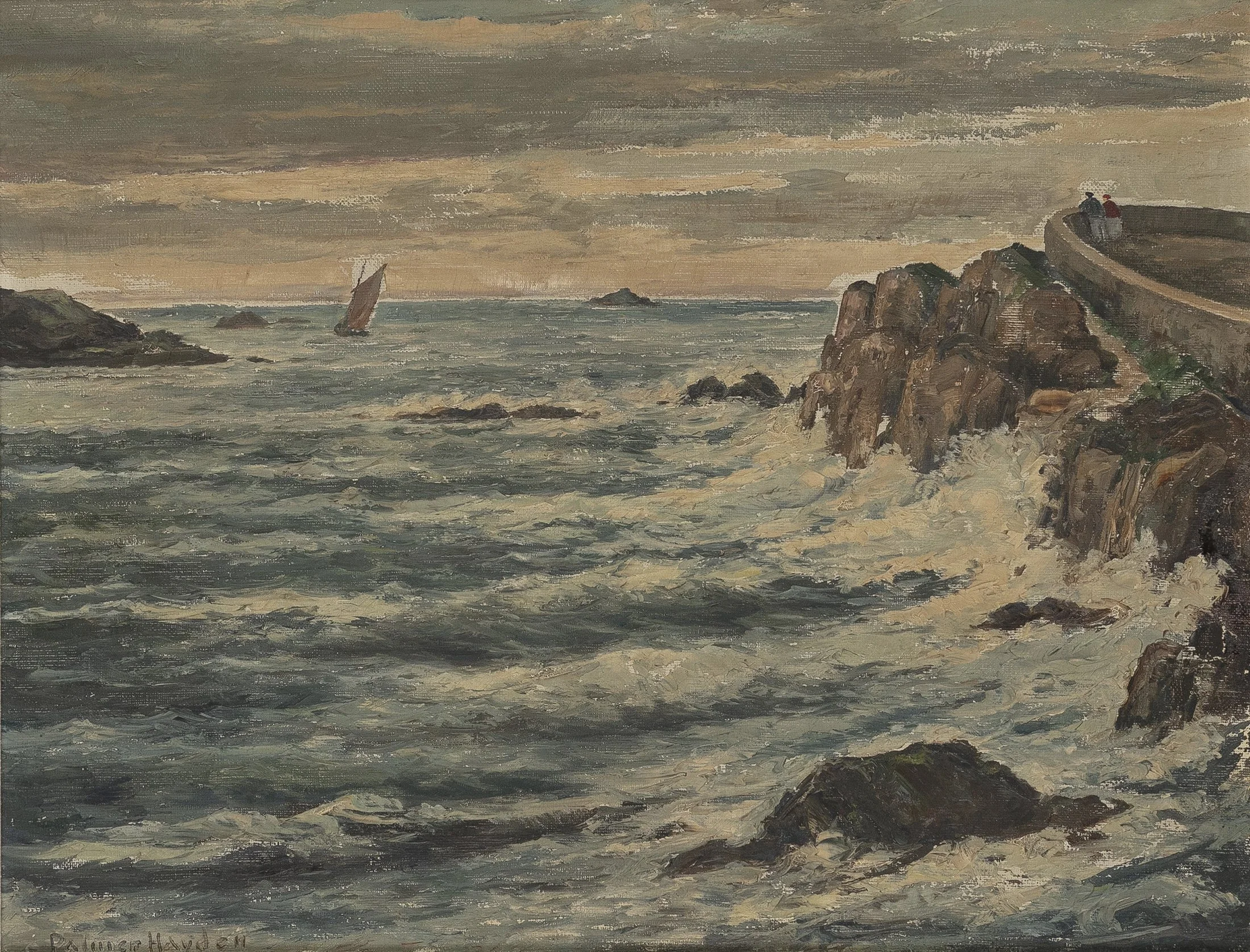
Le Grand Bay
1937
oil on canvas
20 x 26 inches
signed
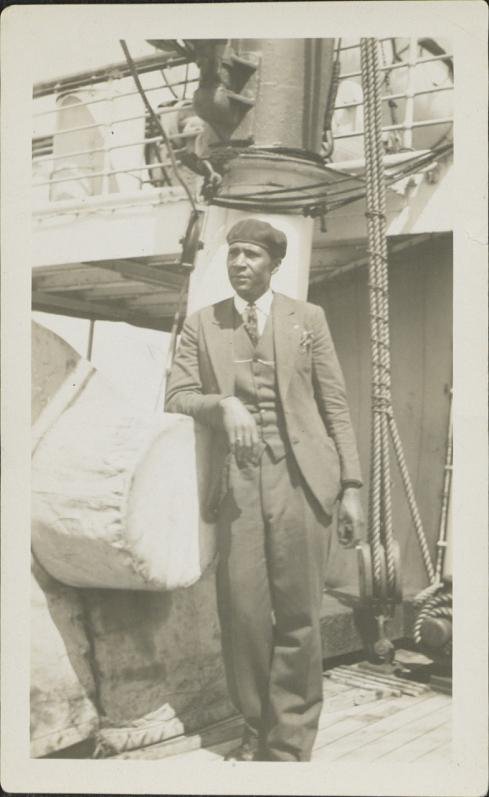
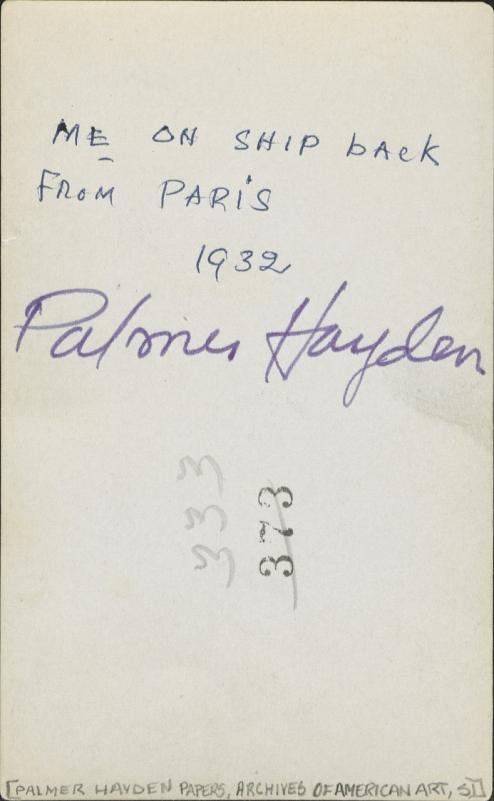
Palmer Hayden (1890–1973) was an important painter of the Harlem Renaissance era whose work encompassed marine landscapes, African American folklore, and scenes of everyday Black life. Born Peyton Cole Hedgeman in Widewater, Virginia, Hayden began drawing as a child. At approximately sixteen, he moved to Washington, D.C., where he supported himself as an errand boy and porter. He later worked as a roustabout for the Ringling Brothers Circus, sketching its animals and performers and producing promotional posters and other graphics.
Hayden enlisted in the United States Army in 1912 and served in the Philippines and with the Tenth Cavalry at West Point. During his military service, he received instruction in map drawing and enrolled in a correspondence course—his first formal art training. After leaving the army in 1920, he settled in New York City and worked at various times as a postal clerk and janitor while studying charcoal drawing at Columbia University and receiving instruction from Victor Perard of the Cooper Union.
A decisive moment in Hayden’s development came in 1925, when he received a working fellowship to study with Asa G. Randall at the Commonwealth Art Colony in Boothbay Harbor, Maine. There, he concentrated on boats, harbors, and coastal scenery, establishing marine painting as one of the enduring subjects of his career. His Boothbay works were presented at the Civic Club in New York in 1926. That same year, his marine watercolor The Schooners received the inaugural Harmon Foundation Gold Medal in Fine Arts and a $400 prize.
With the award money and additional assistance from his patron Alice M. Dike, Hayden traveled to France in 1927. During the next five years, he worked in Paris and along the coast of Brittany, continuing to paint seascapes while expanding his interest in portraiture and figurative subjects. He became acquainted with artists and intellectuals including Hale Woodruff, Henry Ossawa Tanner, and Alain Locke. Hayden received a solo exhibition at Galerie Bernheim-Jeune and participated in the Salon des Tuileries in 1930 and the American Legion Exhibition in 1931. His Parisian watercolors, including café and street scenes, document the social world of Black expatriates in interwar France.
Returning to New York in 1932, Hayden worked for federal art programs, including the Treasury Art Project and the Works Progress Administration. Although he continued to paint waterfronts and landscapes, his work increasingly centered on Harlem life, the rural South, labor, religion, recreation, and African American folklore. Paintings such as Midsummer Night in Harlem and The Janitor Who Paints employ flattened space, emphatic outlines, vivid color, and deliberately stylized figures. The latter, inspired by Hayden’s friend Cloyd Boykin, an artist who supported himself as a janitor, was described by Hayden as a “protest painting” about a society that recognized a Black man’s occupation while disregarding his identity as an artist.
The exaggerated features in some of Hayden’s paintings have generated considerable debate. Some contemporaries regarded them as racial caricatures, while later scholars have examined them in relation to satire, popular illustration, modernism, and Hayden’s effort to develop a distinctive visual language for Black experience.
In 1944, Hayden began his ambitious Ballad of John Henry, a series of twelve paintings devoted to the legendary steel-driving folk hero. The project occupied him for approximately a decade and connected the heroic figure’s story to broader themes of labor, technological change, and African American perseverance. Hayden continued painting until his death in New York in 1973. His work is represented in major collections, including the Smithsonian American Art Museum, the Metropolitan Museum of Art, the National Gallery of Art, and the Museum of African American Art in Los Angeles.
Painted in 1937, Le Grand Bay demonstrates Palmer Hayden’s enduring engagement with the sea, a subject that had first brought him national recognition a decade earlier. Broad, energetic brushstrokes animate the choppy water as waves break against a rocky promontory, while a solitary sailboat and two figures on the distant roadway provide scale and a subtle narrative presence. Hayden’s restrained palette of blue-gray, ocher, brown, and cream captures the shifting light and unsettled atmosphere of the coast. Created after his extended residence in France and during a period in which he was also developing his distinctive paintings of African American life, Le Grand Bay reveals that marine painting remained a vital and persistent element of his practice.
Selected Exhibitions
Solo
Civic Club, NY, 1926. (Generally identified as Hayden’s first solo exhibition, featuring marine and landscape works produced around Boothbay Harbor.)
Galerie Bernheim-Jeune, Paris, FR, 1927-28 (Established Hayden’s reputation during his five-year residence in France.)
Palmer Hayden and Hale Woodruff; 135th Street Branch, New York Public Library, NY, 1929
Palmer Hayden: Southern Scenes and City Streets, Studio Museum in Harlem, NY, 1974. (Major posthumous survey examining his representations of Harlem, the rural South, folklore, labor, and military life. The exhibition ran March 17–April 21, 1974)
Palmer Hayden: Unseen Watercolors and Drawings, Just Above Midtown Gallery, New York, 1975
The Many Facets of Palmer Hayden (1890-1973), Just Above Midtown Gallery, New York, 1977.
Echoes of Our Past: The Narrative Artistry of Palmer C. Hayden, Museum of African American Art, Los Angeles, 1988.
Group
Harmon Foundation, NY, 1928-33. Hayden participated regularly from 1928 through 1932. In 1933, Fétiche et Fleurs received the Mrs. John D. Rockefeller prize.
Salon des Tuileries, Paris, FR, 1930
Contemporary Negro Art, Baltimore Museum of Art, MD, 1939. A landmark museum exhibition devoted to contemporary African American artists. The original version of The Janitor Who Paints was shown here.
The Negro Artist Comes of Age: A National Survey of Contemporary American Artists, Albany Institute of History and Art, NY, 1945.
The Evolution of the Afro-American Artist, City University of New York, 1967.
Two Centuries of Black American Art, Los Angeles County Museum of Art, CA, 1976
Harlem Renaissance: Art of Black America, Studio Museum in Harlem, NY, 1987
African-American Artists, 1929–1945, Metropolitan Museum of Art, New York, 2003.
Just Above Midtown: Changing Spaces, Museum of Modern Art, New York, 2022-2023
The Harlem Renaissance and Transatlantic Modernism, Metropolitan Museum of Art, New York