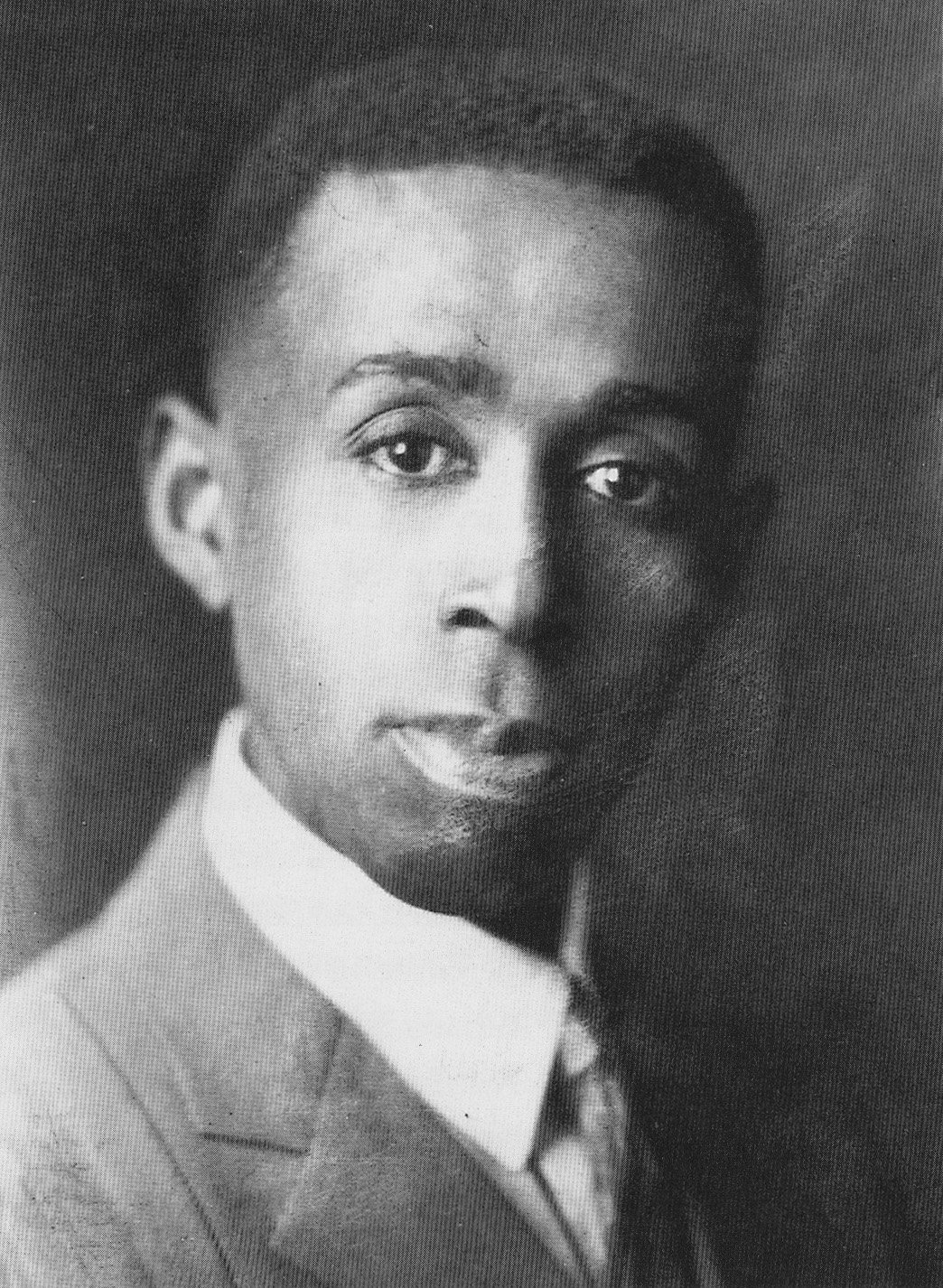
John Wesley Hardrick
(1891-1968)
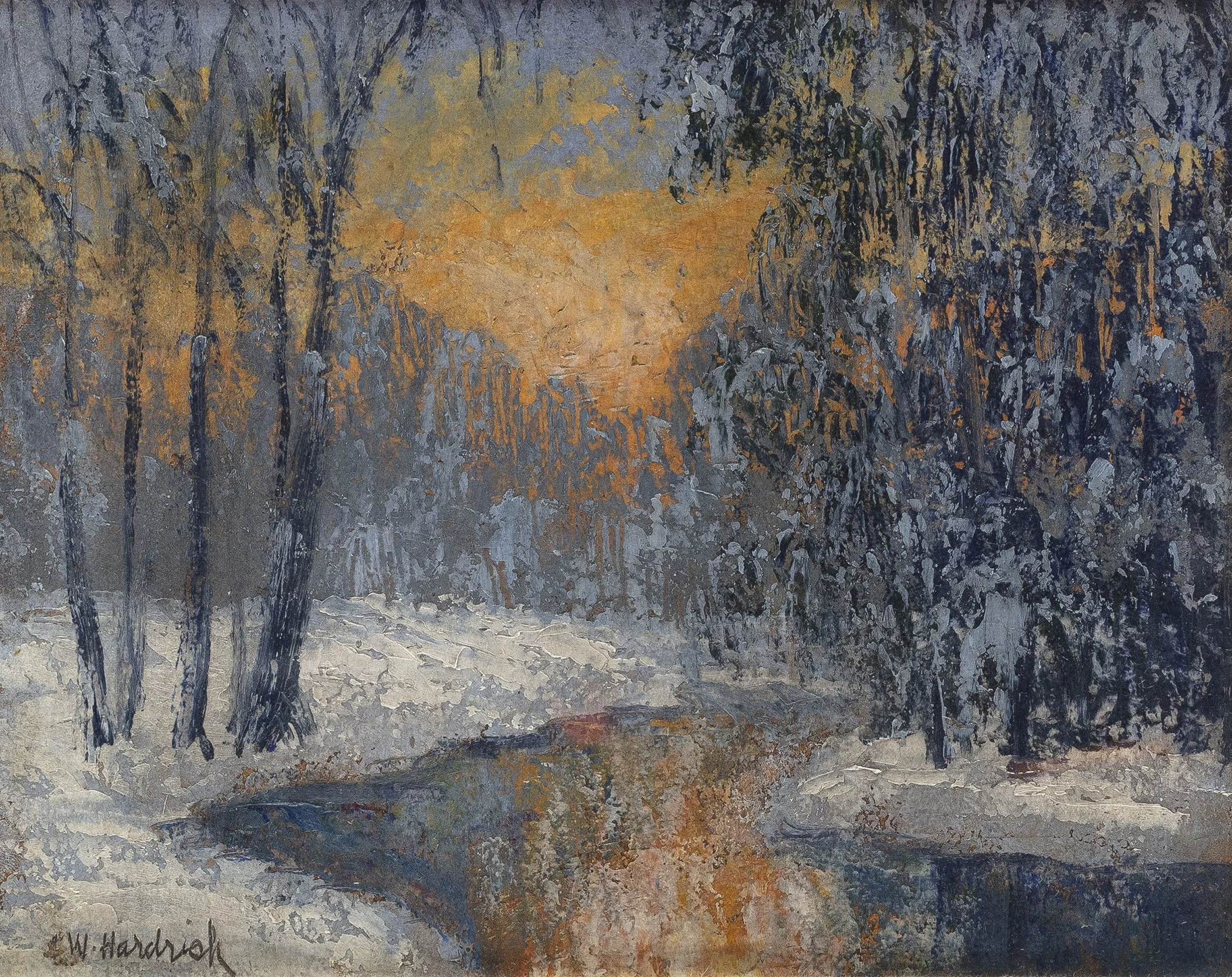
(Late) Fall Landscape
c. 1935
oil on board
8 x 10 inches
signed
John Wesley Hardrick was born in Indianapolis to Shepard and Georgia Etta West Hardrick. His artistic talent emerged at an early age and came to the attention of Herman Lieber, the owner of a local art-supply and framing business. Lieber helped Hardrick enroll in children’s classes at the John Herron School of Art. Their association appears to have continued over the years: many of Hardrick’s paintings remain in frames bearing the Lieber company label.
As a teenager, Hardrick studied with William Forsyth and Otto Stark, prominent painters of the Indiana-based Hoosier Group. He later attended the John Herron School of Art, supporting himself by working nights in a foundry. The experience provided the subject for one of his best-known early paintings, reproduced in the exhibition catalogue A Shared Heritage: Art by Four African Americans.
In 1914, Hardrick married Georgia Ann Howard and held his first major exhibition at Allen Chapel A.M.E. Church. Although the exhibition was successful, increasing family and financial responsibilities repeatedly competed with his artistic ambitions. For a time, he curtailed his studio practice and worked in his family’s trucking business. During the mid-1920s, he shared a studio on Indianapolis’s Indiana Avenue with the younger artist Hale Woodruff.
Hardrick achieved wider recognition in 1927, when he exhibited five paintings at the Art Institute of Chicago in an exhibition organized by the Harmon Foundation. His portrait Little Brown Girl received a bronze medal. Two years later, a group of Black Indianapolis residents purchased the painting and presented it to the John Herron Art Institute, ensuring that the work would become part of the city’s permanent collection. It is now in the collection of the Indianapolis Museum of Art at Newfields.
Hardrick was subsequently represented by four works in the Second Annual Exhibition of Contemporary Negro Art in San Diego. Its catalogue offered a revealing contemporary description of the artist:
“In spite of acute poverty, this young man has the faculty of discerning beauty in everything, being able to face all his adversities with a smile that conceals the feeling within, at the same time he possesses a personality which strangely draws people to him.”
He also exhibited at the Hoosier Salon in 1929, 1931, and 1934, when the annual exhibitions were held at Marshall Field and Company in Chicago. In 1934, he won first prize for portraiture at the Indiana State Fair. He later participated in the American Negro Exposition, held in Chicago in 1940.
Through the federal Public Works of Art Project, associated with the Civil Works Administration, Hardrick received a commission in 1934 to create a mural for Crispus Attucks High School in Indianapolis. Titled Workers, the mural portrayed three Black foundry laborers pouring molten metal. The school’s principal rejected the work, reportedly believing that its depiction of manual labor conflicted with the school’s effort to encourage students to pursue aspirational professions such as medicine and law. The episode is especially poignant given Hardrick’s own experience as a foundry worker and his interest in recognizing the dignity of Black working life.
By 1941, Hardrick’s health was declining, and he began working as a taxi driver. Nevertheless, he continued to paint whenever circumstances allowed. He reportedly kept art supplies in the trunk of his cab and, while waiting for fares, painted local street scenes in rapid bursts. He would sometimes offer the finished paintings for sale directly from the trunk. This resourceful practice exemplified both the economic difficulties he faced and his enduring commitment to his art.
Hardrick was an accomplished portraitist as well as a landscape painter. Many of his portraits depict prosperous Black women who were not simply the wives of successful men but entrepreneurs and community figures in their own right. Rendered with dignity and individuality, these paintings offer an important record of Indianapolis’s Black professional and cultural life.
His landscapes were inspired largely by visits to Brown County, approximately fifty miles south of Indianapolis. Hardrick traveled there throughout the year, observing the countryside in the brilliant colors of autumn, beneath the intense summer sun, and under winter snow. Rather than sketching or painting on location, he absorbed the scenery and committed it to memory. Back in his studio, he transformed these recollections into romanticized and deeply personal interpretations of the Indiana landscape.
Hardrick worked rapidly, generally beginning at the top of the canvas and moving downward. He applied paint thickly with a palette knife, producing richly tactile surfaces, and used brushes primarily to blend passages or define individual shapes. At times, he molded the paint with his thumb, treating the pigment almost as though it were sculptural material. Whenever possible, he mixed his own paints, contributing to the distinctive, earthy yet luminous palette that characterizes his work.
More concerned with atmosphere, color, and emotional expression than with literal description, Hardrick transformed remembered places into evocative visions of the natural world. His approach places him within the broader tradition of African American landscape painting associated with artists such as Edward Mitchell Bannister and Robert S. Duncanson, while his vigorous surfaces and unmistakable palette give his work a character entirely its own.
REF: William E. Taylor and Harriet G. Warkel, A Shared Heritage: Art by Four African Americans, Indianapolis Museum of Art, pp. 41, 47, and 59; and research by Tom Davis for Crown Hill Cemetery, Indianapolis.
Selected Exhibitions
Tenth Annual Exhibition of Works by Indiana Artists; John Herron Art Institute, 1917.
Negro in Art Week, exhibition of primitive African sculpture, modern paintings, sculpture, drawings, applied art, and books; Art Institute of Chicago, 1927.
Harmon Foundation, NY, 1928-1931, 1933, 1935
Pettis Galleries, Indianapolis, IN, 1929.
Exhibition of the Art of the American Negro (1851-1940); Tanner Art Galleries, Chicago, IL, 1940.
Black Artists in Historical Perspective; Schenectady Museum of Art, NY, 1976.
A Shared Heritage: Art by Four African Americans; Indianapolis Museum of Art, IN, 1996.
The Great Migration: The Evolution of African American Art, 1790-1945; Taft Museum of Art, Cincinnati, OH, 2000.
Through the Eyes of an Artist: John Wesley Hardrick; Indiana State Museum, 2025