Eugene Grigsby
(1918-2013)
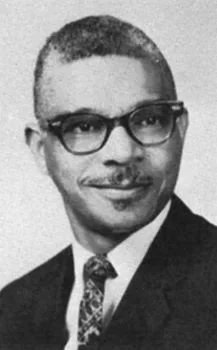
Bountiful
1998
color woodblock print
8-1/4 x 5-1/4 inches (image), full margins
signed, dated, titled, and numbered, A/P I
Jefferson Eugene Grigsby Jr. (1918–2013) was a painter, printmaker, educator, author, and community activist whose career united artistic practice with a lifelong commitment to social justice and culturally inclusive education. Born in Greensboro, North Carolina, and raised in Charlotte and Winston-Salem, he discovered the possibility of becoming an artist through Walker Foster, a self-taught painter and stonemason who welcomed the young Grigsby into his studio. After briefly attending Johnson C. Smith University, Grigsby transferred to Morehouse College, where he studied with Hale Woodruff and earned his bachelor’s degree in 1938. He subsequently studied at the American Artists School in New York, becoming immersed in Harlem’s community of Black artists and intellectuals, before earning an M.A. from Ohio State University in 1940. He later completed additional studies at Columbia University and the École des Beaux-Arts in Marseille, France.
During World War II, Grigsby served as a master sergeant in the 573rd Ordnance Ammunition Company under General George Patton and became his battalion’s unofficial photographer. After the war, he settled in Phoenix, where in 1946 he established and chaired the art department at the segregated Carver High School. Following the school’s closure during desegregation, he taught at Phoenix Union High School. In 1958, the Museum of Modern Art selected him as one of six educators to teach at the Children’s Creative Center in the United States Pavilion at the Brussels World’s Fair. Grigsby earned his Ph.D. from New York University in 1963 with a dissertation comparing the masks of the Indigenous Kwakwaka’wakw peoples of the Pacific Northwest with those of the Kuba Kingdom in Central Africa. He joined Arizona State University in 1966, teaching art education until his retirement in 1988.
Grigsby’s paintings and prints evolved from figurative scenes of everyday African American life toward increasingly expressionistic and abstract compositions. Inspired by the Civil Rights Movement and his travels through Africa, including a 1972 teaching sabbatical, his work addressed family, spirituality, cultural identity, racial injustice, and the resilience of oppressed communities. African and Indigenous artistic traditions became integral to his visual vocabulary.
His influential book, Art and Ethnics: Background for Teaching Youth in a Pluralistic Society (1977), broadened the teaching of American art to include African American, Indigenous, Latino, and, in its later edition, Asian American traditions. Grigsby also founded community arts initiatives, including the Consortium of Black Artists and Others for the Arts, which created exhibition and educational opportunities for underserved young people. Named National Art Educator of the Year in 1988, he was honored by the Congressional Black Caucus in 2007 for his contributions to African American art and education. In 2001, the Phoenix Art Museum surveyed his career in The Eye of Shamba: The Art of J. Eugene Grigsby Jr., a sixty-five-year retrospective.
Selected Exhibitions
Solo
The Art of EUGENE GRIGSBY, JR.: The Eye of Shamba; Phoenix Art Museum, AZ, 2001
Eugene Grigsby: Works on Paper; Arizona State University Art Museum, Tempe, AZ, 2002
Eugene Grigsby: 89 Years, 89 Pieces - A Celebration; Heddenart Gallery, Scottsdale, AZ, 2007
Selected Works of J. EUGENE GRIGSBY, JR.: Returning to Where the Artistic Seed Was Planted; Harvey B. Gantt Center for African American Arts + Culture, Charlotte, NC, 2015
Group
2nd Annual Exhibit of African American Artists; Dillard University Art Gallery, New Orleans, LA, 1938
Exhibition of the Art of the American Negro (1851-1940); Tanner Art Galleries, Chicago, IL, 1940
New Perspectives in Black Art; Kaiser Center Gallery, Oakland Museum of Art. CA, 1968
National Exhibition of Black Artists; Smith-Mason Gallery of Art (in cooperation with the National Bank of Washington), Washington, DC, 1971
Reflections: the Afro-American artist: an exhibit of paintings, sculpture, and graphics; Benton Convention Center, Winston-Salem, NC, 1972
Black Artists / South; Huntsville Museum of Art, AL, 1979
The First Annual Atlanta Life National Art Competition and Exhibition; Atlanta Life Insurance Co., Atlanta, GA, 1980
ABC/AZ. Thirteen Artists of the Black Community; Arizona State University Art Museum, Tempe, AZ, 1991
Celebration and Vision: The Hewitt Collection of African-American Art, Bank of America Gallery and Mint Museum of Art, Charlotte, NC, 1999
Locating the Spirit: Religion and Spirituality in African American Art; Anacostia Museum and Center for African American History and Culture, Washington, DC, 1999
Ascension: Works by African American Artists of North Carolina; Diggs Gallery, Winton-Salem State University, NC, 2005
Southern Journeys: African American Artists of the South; Appleton Museum, Ocala, FL, 2010
MAHALIA: Queen of Gospel Music, Stella Jones Gallery, New Orleans, LA, 2011
Three Legacies, Carver Museum, Phoenix, AZ, 2012
Twentieth Century Works on Paper by Artists of the Diaspora; Stella Jones Gallery, New Orleans, LA, 2013