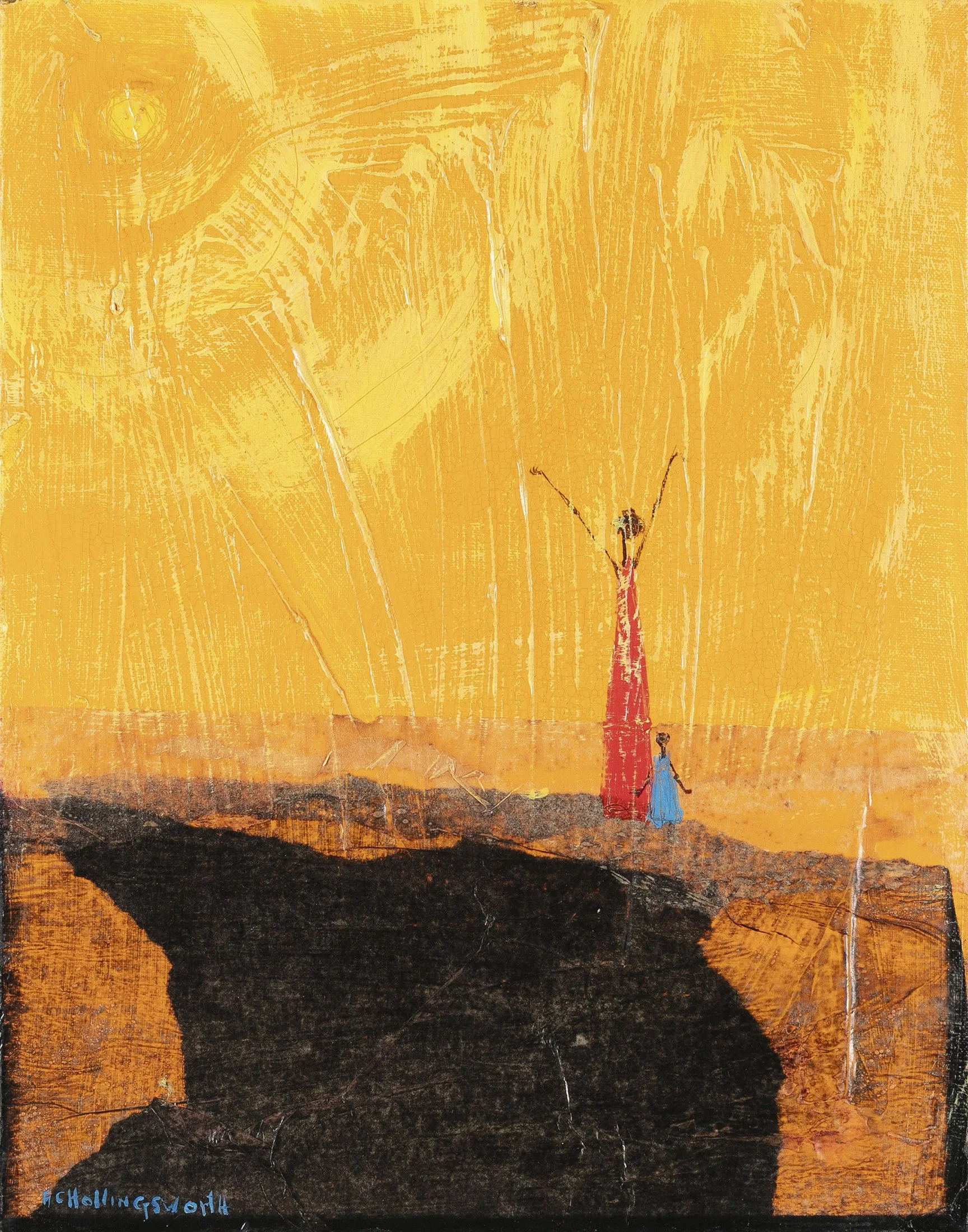
Alvin C. Hollingsworth
(1928-2000)
untitled
c. 1970
oil on canvasboard
14 x 11 inches
signed
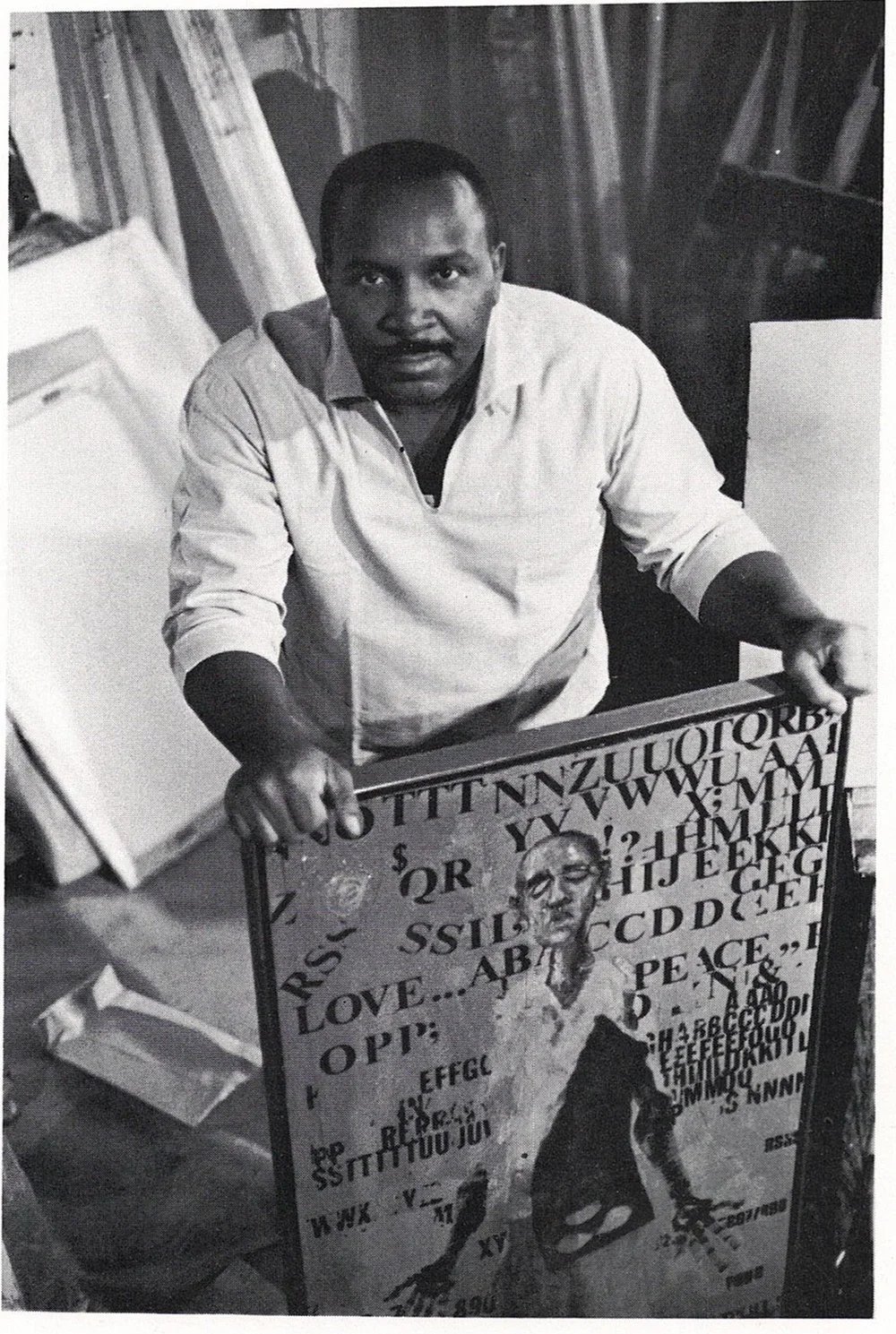
Alvin Carl Hollingsworth (1928–2000) was a painter, illustrator, educator, and pioneering comic-book artist whose work explored Black urban life, spirituality, social justice, women, and jazz. Born in Harlem to Barbadian parents, Hollingsworth began drawing at four and, by the age of twelve, was working after school as an art assistant on Holyoke Publishing’s Cat-Man Comics. He attended New York’s High School of Music & Art and became one of the earliest African American artists to work regularly in mainstream comic books. During the 1940s and 1950s, he contributed to adventure, crime, romance, horror, and war publications, sometimes using the name Alvin Holly. He later worked on the newspaper strips Scorchy Smith, Marlin Keel, and his own syndicated feature, Kandy. Hollingsworth earned his bachelor’s degree from the City College of New York in 1956, graduating Phi Beta Kappa, and completed a master’s degree there in 1959.
By the mid-1950s, Hollingsworth had turned his attention toward fine art, moving fluidly between abstraction and figurative expressionism while retaining the bold contours, narrative immediacy, and dramatic compositions of his illustration work. His first solo exhibition, Exodus, was presented at New York’s Ward-Eggleston Gallery in 1961. He frequently developed ideas through sustained thematic series, working in painting, drawing, printmaking, collage, and assemblage. In Cry City (1963–65), he incorporated materials salvaged from city streets to examine poverty, alienation, and racial inequality within the urban environment.
In 1963, Hollingsworth joined Spiral, the influential collective of Black artists who gathered to debate the artist’s relationship to the Civil Rights Movement. Its members included Romare Bearden, Charles Alston, Norman Lewis, Richard Mayhew, Hale Woodruff, and Reginald Gammon. The experience strengthened Hollingsworth’s commitment to social concerns without restricting him to a single aesthetic language. His subsequent Prophet Series presented a Black Christ as a universal symbol of spiritual leadership, connecting biblical imagery with modern figures such as Martin Luther King Jr. and Malcolm X. Other bodies of work celebrated jazz, explored the subconscious, or honored the resilience of Black women. “I take my hat off doubly to the Black woman,” Hollingsworth explained in 1977. “I wanted people to recognize the pride of women, the spiritual quality of women, the sacrifices of women.”
Hollingsworth extended his commitment to accessibility through teaching, publishing, public art, and television. He directed art instruction at the Harlem Parents Committee Freedom School, taught at the High School of Art and Design and the Art Students League, and hosted NBC’s ten-part instructional series You’re Part of Art in 1970. That year he also wrote and illustrated the children’s book I’d Like the Goo-Gen-Heim, illustrated Arnold Adoff’s poetry anthology Black Out Loud, and created murals inspired by Don Quixote for a Bronx housing complex. He later taught at Hostos Community College of the City University of New York, retiring in 1998.
Hollingsworth’s work is represented in the Smithsonian National Museum of African American History and Culture, Brooklyn Museum, Hudson River Museum, and Harvey B. Gantt Center for African-American Arts + Culture. In 2024–25, the Hudson River Museum organized Alvin C. Hollingsworth: And All That Jazz, his first museum exhibition in more than fifty years, reaffirming the breadth of a career that bridged popular illustration, modern painting, education, and cultural advocacy.